Dr. Gymbro
←

#sports nutrition

50 articles
supplements

La Boisson Énergétique Sans Sucre qui a ajouté 1,2 mph à la vitesse de sortie des batteurs

BY COACH RYAN ·

Une boisson énergétique sans sucre a légèrement augmenté la vitesse de sortie moyenne d’environ 1,2 mph chez des joueurs de baseball et de softball expérimentés, avec un pic d’environ 1,6 mph. L’étude en double‑aveugle menée à Auburn a aussi montré que la hauteur de saut restait stable, alors qu’elle baissait avec le placebo. En revanche, la vitesse de la barre, le temps de réaction et l’énergie perçue n’ont pas bougé, et les coups ont été effectués depuis un tee, pas face à un lanceur réel. Un des co‑auteurs travaille également pour le distributeur de la boisson. Voici ce que les batteurs devraient et ne devraient pas retenir.

nutrition

Boire 60 g de glucides pendant la séance rend‑il plus fort ? Pas vraiment

BY DR. GYMBRO ·

Les boissons glucidiques intra‑entraînement sont omniprésentes, mais augmentent‑elles réellement votre force ? Un essai pilote randomisé, contrôlé par placebo et en cross‑over, portant sur 15 adultes entraînés en résistance, a testé 60 g de maltodextrine pendant une séance de musculation à charge égale. La glycémie a augmenté d’environ 19 mg/dL, alors que le lactate, la force réactive et la force de préhension n’ont montré aucun changement net. Les répétitions d’extension du genou à l’échec étaient environ 2,5 supérieures avec les glucides, mais ce signal provenait de seulement 10 personnes et n’était pas significatif après ajustement. Voici ce que l’étude démontre réellement, qui pourrait encore en bénéficier, et pourquoi il s’agit d’une génération d’hypothèses plutôt que d’un feu vert.

nutrition

Le chocolat noir augmente de 4,3 cm le saut vertical des femmes : cela vous intéresse ?

BY DR. GYMBRO ·

Une étude récente montre que des athlètes féminines de CrossFit ont sauté en moyenne 4,3 cm plus haut après trois jours de consommation de 30 g/jour de chocolat noir à 85 % de cacao, comparé à un placebo. La force du genou s’est aussi améliorée, tandis que la douleur musculaire est restée quasiment inchangée. Les auteurs soulignent que ces effets, bien que remarquables, restent préliminaires et nécessitent une confirmation. Ce résumé passe en revue la dose, le timing, la population étudiée et explique pourquoi il s’agit d’un signal prometteur, et non d’une preuve définitive.
A wide, editorial-style still life shot from a slightly elevated three-quarter angle on a pale oak gym bench, lit by soft morning window light. In the foreground sits a minimalist matte-white glass beaker of clear, faintly amber liquid, with a few condensation droplets on its surface. Beside it rests a small ceramic dish of white crystalline powder and a stainless steel scoop. In the middle ground, a chalk-dusted steel barbell with black bumper plates rests on the bench's edge. A pair of worn leather lifting straps and a small notebook with a pencil lie nearby, suggesting data logging. Behind them, softly blurred, is a bright, airy studio with concrete walls, a wooden plyo box, and a tall leafy plant catching the light.

The palette is warm and muted: cream, sand, soft sage green, and charcoal, with one small accent of burnt orange in the amber liquid and a terracotta towel draped over the bench. Fine chalk dust floats in sunbeams that cut diagonally across the frame. The shallow depth of field keeps the beaker and barbell sharp while the background melts into creamy bokeh. Composition follows the rule of thirds, with the beaker on the left third and generous negative space on the right for headline text. The mood is calm, premium, and contemporary, like a high-end wellness and sports-science magazine photograph with subtle film grain, natural shadows, and realistic textures.
nutrition

Les cétones ont maintenu une production de force 8 % plus élevée, mais les sauts n’ont pas changé

BY DR. GYMBRO ·

Une dose de 50 g de bis‑octanoyl‑(R)-1,3‑butanediol a fait grimper le taux sanguin de cétones à ≈ 2,2 mM et a permis de conserver un taux de développement de la force (RFD) 8 % plus élevé une heure après ingestion, sans aucune amélioration du saut en contre‑mouvement. L’étude, réalisée chez 20 adultes actifs, montre un effet potentiel sur la fatigue de force, mais reste préliminaire.
A wide, editorial-style landscape photograph of a calm, sunlit studio scene. In the center-left, a young man's bare lower leg and ankle are planted on a matte sand-colored yoga mat, heel slightly lifted in a mid calf-raise. The Achilles tendon and calf muscle are defined by soft, directional window light, with gentle shadows that emphasize natural contours. On a pale oak wooden surface at the right of the frame sits a minimalist glass of water beside a small ceramic bowl of fine white collagen peptide powder, with a wooden scoop resting on the rim. A few loose grains of powder catch the light. Beside them is a muted sage-green matte canister with no legible text or branding.

In the soft-focus background, a clean off-white wall and a tall linen curtain diffuse warm morning light. A slim notebook with a pencil and a small analog stopwatch lie on the wood, hinting at measured testing. The palette is restrained and modern: warm cream, sand, soft sage, pale oak, and subtle terracotta accents. Shallow depth of field with a creamy bokeh background, crisp focus on the ankle and tendon. The mood is quiet, thoughtful, and scientific without being clinical, like a contemporary wellness and science journal cover. Natural film-like grain, balanced negative space on the upper right for headline placement, and a soft, high-end magazine aesthetic. No text, no logos, no futuristic elements.
nutrition

Les peptides de collagène ont renforcé la rigidité des tendons et augmenté la puissance explosive

BY DR. GYMBRO ·

Le collagène n’est pas seulement un allié de la beauté. Dans un essai randomisé de 16 semaines, 10 g de peptides de collagène par jour ont rendu le muscle du mollet et le tendon d’Achille plus rigides et ont accéléré la production de force chez de jeunes hommes sédentaires. En revanche, la force maximale et la taille musculaire sont restées inchangées. Les auteurs sont rattachés à Morinaga, fabricant de compléments, et l’étude porte sur un groupe très restreint. Voici ce que montrent les données, qui pourraient en profiter, et ce qui reste à prouver.
A bright, minimalist still life on a soft sage-green and warm cream backdrop, shot from a slightly elevated angle in natural morning window light. In the center sits a matte ceramic bowl of creamy vanilla protein shake with a wooden spoon resting beside it. Next to it, a small glass jar with a few off-white probiotic capsules spilling onto a pale linen napkin. Around them are fresh, gut-friendly foods arranged with editorial restraint: a halved ripe banana, a small bowl of plain yogurt with a swirl on top, a few stalks of leeks, a handful of oats scattered on the surface, and a sprig of fresh mint. A tall glass of water with a lemon slice catches the light and casts a delicate caustic shadow across the table.

In the background, slightly out of focus, a folded gray gym towel and a sleek stainless steel shaker bottle hint at an athletic lifestyle without dominating the scene. The surface is a pale oak tabletop with subtle grain. A soft diffused shadow falls to the left, giving gentle depth.

The palette is calm and modern: sage green, oatmeal, warm white, soft butter yellow, and touches of terracotta from a small clay dish holding a pinch of sea salt. The composition leaves generous negative space on the right third for headline overlay. The mood is clean, wellness-focused, and quietly editorial, like a feature in a contemporary health and science journal. Shallow depth of field, crisp focus on the capsules and bowl, subtle film grain, and natural color grading. No people, no text, no logos, no futuristic elements.
nutrition

Flatulences protéinées ? Le probiotique BB536 réduit les odeurs, mais seulement chez certains intestins

BY DR. GYMBRO ·

Des flatulences malodorantes dues à un régime riche en protéines ? Un essai a évalué le probiotique *Bifidobacterium longum* BB536 chez des athlètes et a constaté une diminution de composés odorants comme le méthylmercaptan et l’ammoniaque, mais uniquement dans certains sous‑groupes. L’étude, petite et exploratoire, était financée par le fabricant du probiotique. Voici ce qu’est le BB536, pourquoi votre microbiote de base peut déterminer qui en bénéficie, et des solutions moins coûteuses à essayer d’abord.
A wide, softly lit editorial still life on a warm off-white linen surface. In the foreground, a matte ceramic bowl holds creamy plain yogurt topped with fresh blueberries and a drizzle of honey. Beside it sit a small glass jar of pale kefir, a few fermented vegetables in a shallow dish, and a spoon with a dusting of oats. A pair of worn, dark red boxing hand wraps lies loosely coiled in the middle ground, partly unrolled across the linen. A slim brushed-steel digital kitchen scale sits just behind them, its display blurred. A small glass bottle with a minimalist cream label and a few capsules spilled onto a wooden tray add a subtle supplement cue. At the right edge, a folded gray towel and a sleek water bottle hint at training without cluttering the scene.

The background is a softly out-of-focus pale sage-green wall with gentle diagonal window light that casts long, delicate shadows and a warm golden highlight along the left side. The color palette is muted and modern: sage, oatmeal, terracotta, deep crimson, and touches of cobalt from the blueberries. The composition uses generous negative space on the upper right for headline overlay, with the objects arranged along a low diagonal from lower left to center right. Shallow depth of field, crisp textures on the ceramic, the grain of the wood, and the weave of the wraps. The mood is calm, clean, and quietly athletic, like a high-end health and science magazine cover. Photographic realism, natural color grading, subtle film grain, and a slightly overhead three-quarter camera angle.
nutrition

Probiotiques pendant une coupe de poids : les athlètes ont perdu davantage de graisse corporelle

BY DR. GYMBRO ·

Perdre du poids avant un combat est une épreuve difficile, mais une nouvelle étude suggère que le microbiote intestinal pourrait rendre le processus un peu plus efficace. Chez 32 athlètes de sports de combat soumis à une réduction de poids de 4 semaines, ceux ayant pris un probiotique ont perdu un pourcentage de graisse corporelle plus élevé que le groupe placebo. Ils présentaient également des triglycérides et du LDL‑C plus bas, des acides gras à chaîne courte plus élevés et une moindre hausse des acides gras libres circulants. Cependant, tous ont tout de même perdu du muscle, et l’étude reste petite, courte et limitée à un seul sport. Voici ce que les données montrent, ce qu’elles n’indiquent pas, et comment envisager les probiotiques comme un complément plutôt qu’un raccourci.
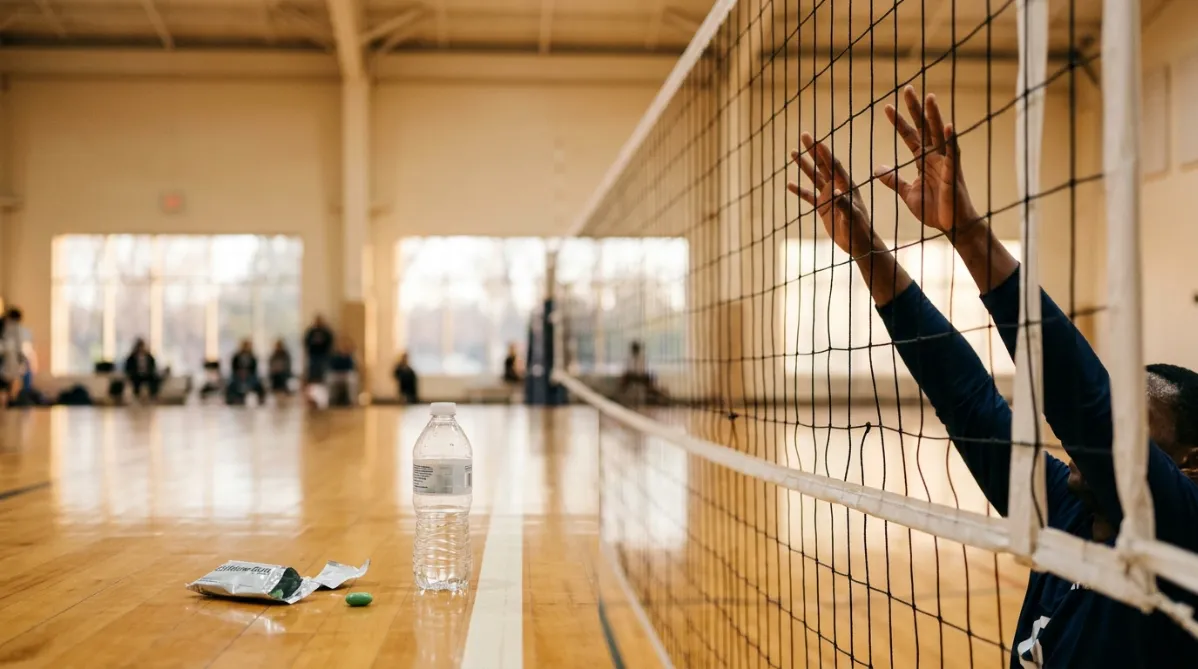
A landscape editorial photograph of a volleyball net in a softly lit indoor gym, shot from a low angle on the court. In the foreground, a pair of athletic hands in mid-block reach above the net, fingers spread, caught in crisp focus. The athlete's face is out of frame, so the attention stays on the hands and the net. In the lower left foreground, a small open foil pack of caffeine chewing gum sits on the polished maple floor, with two mint-green gum pieces beside it and a clear water bottle. The pack is unbranded and minimal.

The background is a warm blur of honey-toned hardwood, pale gym walls, and tall windows with diffused late-afternoon light streaming in. Dust motes glow in the light shafts. The palette is muted and modern: warm wood amber, soft cream, sage green, and a touch of deep navy from the athlete's jersey. Shallow depth of field and gentle film grain give the image a refined, magazine-like feel. The composition follows the rule of thirds, with the hands and net on the right and open negative space on the left, where headline text could sit.

The mood is calm, focused, and slightly cinematic, like a feature in a contemporary sports science journal. The lighting is soft and natural, with long gentle shadows across the court lines. No futuristic or digital elements, no charts, no text. The overall look is clean, tactile, and editorial.
nutrition

Fatigue : les temps de réaction ralentissent de 18 %. Le chewing‑gum à la caféine ne les réduit qu’à 3 %

BY DR. GYMBRO ·

Après un protocole de fatigue très exigeant, les joueuses de volleyball d’élite sous placebo ont vu leurs temps de réaction augmenter de 18,4 %. Un chewing‑gum contenant 6 mg/kg de caféine n’a limité ce ralentissement qu’à 3,0 %, tandis que 3 mg/kg n’ont entraîné qu’une hausse de 6,4 %. La puissance au saut‑bloc et la raideur du saut‑dégressif se sont également mieux maintenues avec la caféine. L’étude, toutefois, ne comporte que 15 athlètes, l’aveugle était incomplet et les effets indésirables étaient plus fréquents à la dose la plus élevée.
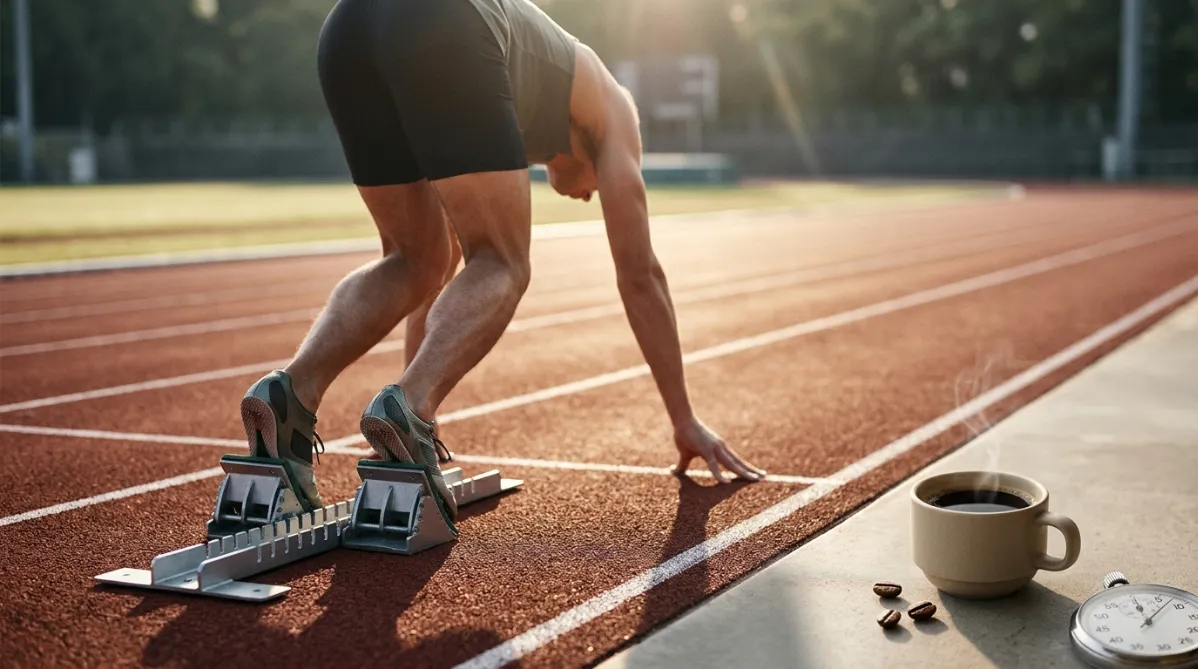
A wide, editorial-style photograph of a sprinter crouched in starting blocks on a deep terracotta-red running track, shot from a low angle at the side as the first morning light rakes across the lanes. The athlete is mid-set, hips lifted, hands poised behind crisp white lane lines, with a soft focus on their muscular calves and spiked shoes in the foreground. Warm golden sunlight creates long, elegant shadows and subtle lens flare, while the distant lanes fade into a creamy bokeh.

In the lower right foreground, slightly out of focus, sits a minimalist still life on a matte concrete ledge beside the track: a small ceramic cup of black coffee with a thin wisp of steam, two loose roasted coffee beans, and a simple stopwatch with a clean white face. The ceramic is a muted sand color, adding a refined, modern lifestyle touch.

The color palette is restrained and trendy: terracotta, warm cream, soft charcoal, and a hint of sage green from trees blurred in the far background. The composition uses generous negative space across the upper left, ideal for headline text overlay. The look is similar to a contemporary health and sports science magazine: natural film-like grain, gentle contrast, shallow depth of field, and a calm, focused mood. No text, no logos, no graphics, and no futuristic elements, just a realistic, tactile, sunlit scene that suggests precision, preparation, and explosive speed.
science research

Double de caféine, sprints plus rapides ? Ce que 6 mg/kg apporte réellement

BY DR. GYMBRO ·

Un essai randomisé, en double‑aveugle et en croisé, a comparé 3 mg/kg à 6 mg/kg de caféine chez 21 sprinteurs masculins entraînés. Les deux doses ont dépassé le placebo, mais la dose élevée n’a apporté de gain de vitesse supplémentaire que sur les 30 m et 60 m, pas sur les 10 m. Elle a également amélioré la hauteur de saut et le développement de la force au bloc, sans effet additionnel sur le temps de réaction ni sur la puissance maximale au test de Wingate. Voici ce que ces doses représentent en milligrammes pour un athlète de 70 à 80 kg, quand les prendre, à qui les résultats s’appliquent et ce que l’étude n’a pas indiqué concernant les effets indésirables.

A landscape editorial photograph in a bright, modern gym studio with soft natural light pouring through tall windows. In the foreground, a matte ceramic cup and a small glass jar of plain white powder sit on a light oak bench, with a wooden scoop resting beside them and a few loose grains dusted across the wood. The jar has no label, which hints at mystery without being heavy-handed. Slightly out of focus behind them, a female athlete in a sage green athletic set stands at a barbell, chalked hands gripping the bar, her expression calm and focused. A male cyclist on a stationary bike is blurred in the far background. The palette is warm neutrals: cream, soft sand, pale oak, muted sage, and a touch of terracotta, with gentle golden-hour highlights and soft shadows. The composition follows the rule of thirds, with the cup and jar in the lower left, the athlete on the right, and open negative space in the upper area for headline text. The depth of field is shallow, with a creamy bokeh background. The mood is contemplative, curious, and trendy, like a contemporary health and science magazine cover. Fine film grain, subtle matte finish, clean minimalist styling, and no text or logos.
science research

La fausse caféine rend les athlètes plus forts et plus rapides

BY DR. GYMBRO ·

Et si une partie de votre boost avant l’entraînement venait de votre tête plutôt que de la cuillère ? Une méta‑analyse de 2026 portant sur 17 études a montré qu’un placebo que les athlètes croyaient être de la caféine améliorait néanmoins la performance sportive (d = 0,49), que ce soit au développé couché, aux contre‑temps cyclistes ou aux sprints répétés. Les effets étaient plus forts lorsque les chercheurs étaient aveugles et dans les études incluant davantage de femmes, bien que les preuves soient de faible certitude et à haut risque de biais. Cela ne justifie pas d’abandonner la vraie caféine à 3‑6 mg/kg, mais cela rappelle que l’attente est elle‑même une variable de performance. Voici ce que disent les données et pourquoi il faut rester prudent.
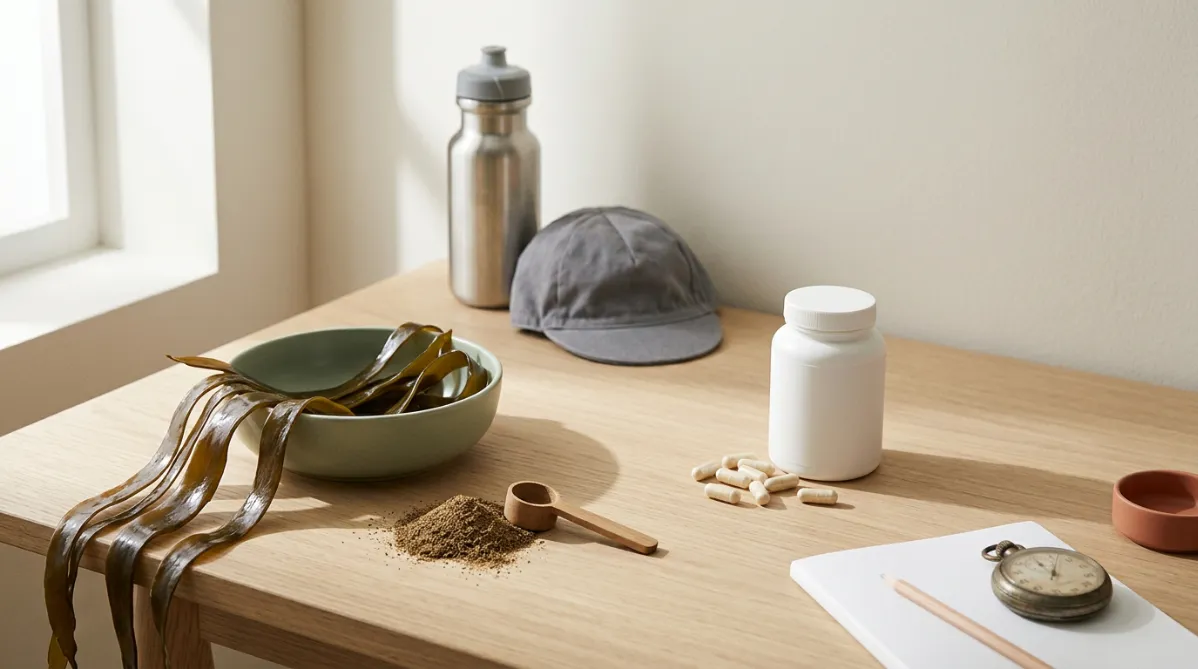
A landscape editorial still life in soft natural window light, set on a pale oak tabletop with a matte warm-white wall behind it. In the center-left, a few glossy strands of dark olive-brown kelp (Ecklonia cava) drape in an elegant curve over a shallow ceramic bowl in muted sage green. Next to the bowl, a small pile of fine, dry brown seaweed powder sits beside a minimalist wooden scoop. On the right, an unbranded matte-white supplement tub and a few loose cream-colored capsules are spilled neatly across the surface. A brushed steel cycling water bottle stands slightly out of focus in the background, with a folded gray cycling cap beside it. In the foreground, a clean white notebook with a thin pencil rests next to a simple analog stopwatch, hinting at a performance trial without any text or numbers visible.

The palette is earthy and calm: sage, olive, warm sand, cream and soft charcoal, with one subtle terracotta accent from a small ceramic dish. Long soft shadows fall diagonally across the table, and a gentle highlight catches the wet sheen of the seaweed. Shallow depth of field, with a creamy blurred background and crisp detail on the seaweed texture and capsules. The composition leaves generous negative space on the upper right for a headline overlay. Shot as if with a 50mm lens at f/2.8, top-down angle tilted about 30 degrees, in a modern wellness-magazine style that is minimalist, tactile and refined, with a subtle film-like grain and natural color grading.
nutrition

L'algue brune dans votre pré‑entraînement fait‑elle réellement quelque chose ?

BY DR. GYMBRO ·

L’extrait d’algue brune *Ecklonia cava* apparaît dans les compléments pré‑entraînement et les brûleurs de graisse, mais améliore‑t‑il vraiment vos performances ? Un essai randomisé, en double‑aveugle et croisé, a été réalisé chez 12 cyclistes entraînés qui ont reçu 263 mg d’extrait ou un placebo avant une heure de pédalage suivie de sprints maximaux. La glycémie a légèrement augmenté, tandis que le lactate, la consommation d’oxygène, l’utilisation des graisses par rapport aux glucides et la puissance de sprint sont restés inchangés. La petite taille de l’échantillon empêche d’exclure de minuscules effets, mais aucune preuve ne soutient un boost de performance aigu. Voici ce qui a été testé, ce que cela signifie et où votre argent pourrait être mieux dépensé.
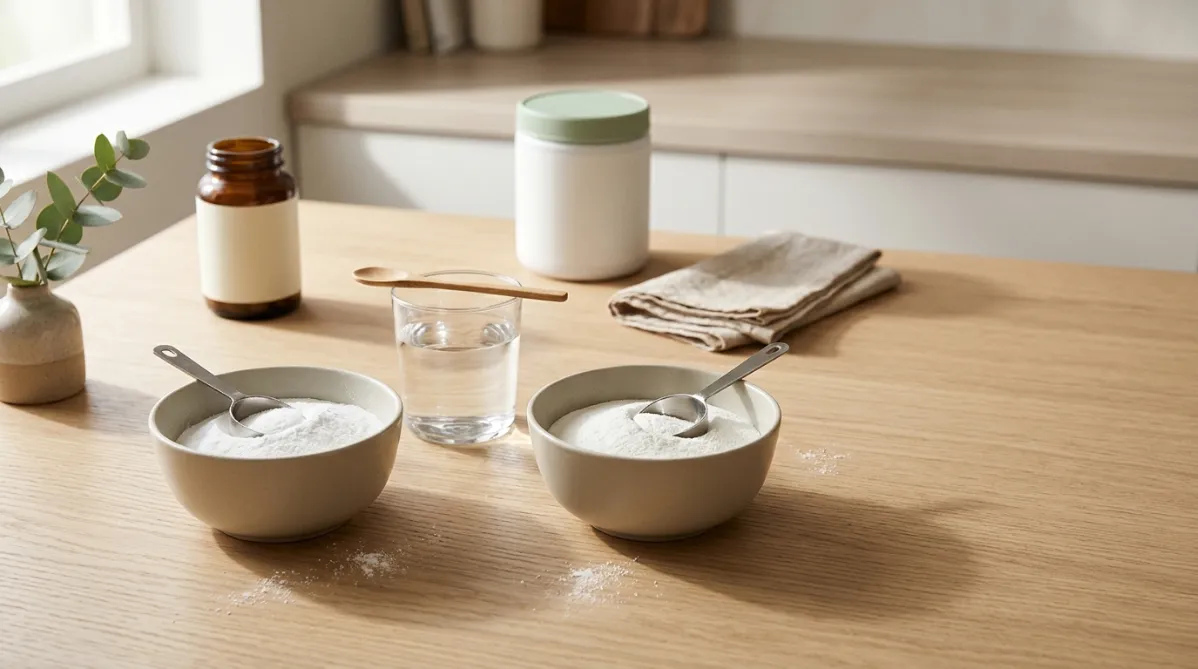
A wide, landscape editorial photograph of a clean, sunlit kitchen countertop in soft morning light. Two matching matte ceramic bowls sit side by side on a pale oak wood surface. One holds fine, bright white creatine powder, the other holds an almost identical powder, with a small stainless steel scoop resting in each. Between them sits a simple glass of water with gentle ripples and a thin wooden stirring spoon. In the soft-focus background, a minimalist amber glass supplement jar with a plain cream label and a sleek matte-white tub with a pastel sage-green lid stand slightly out of focus, suggesting a budget option and a premium option without any readable branding. A small, neatly folded linen napkin in warm oatmeal tones and a sprig of eucalyptus in a tiny stoneware vase add a calm, modern touch.

A few grains of powder are scattered naturally across the wood, catching the light. The color palette is warm neutrals with soft sage green, cream, and muted terracotta accents. The composition uses a shallow depth of field, a slightly elevated three-quarter angle, and generous negative space on the right side for title overlay. The lighting is natural window light from the left, creating long, gentle shadows and a subtle glow on the powder. The overall mood is calm, trustworthy, and thoughtful, like a contemporary health and wellness magazine or a minimalist lifestyle journal. High-resolution, crisp textures, film-like color grading, subtle grain, and a balanced, symmetrical sense of comparison between the two bowls.
nutrition

Cette créatine « plus absorbable » vient d'égaler le monohydrate ordinaire

BY DR. GYMBRO ·

Le marché de la créatine haut de gamme mise sur des promesses d’absorption supérieure et d’estomac plus doux, mais le monohydrate classique bénéficie d’une solide base de données scientifiques et d’un prix bas. Un essai randomisé, en double‑aveugle et en crossover, a comparé le produit plus récent OptiCreatine au monohydrate chez 17 jeunes adultes en bonne santé. Après une dose unique de 5 g, les courbes sanguines de créatine, les pics, le timing et les symptômes gastro‑intestinaux étaient statistiquement similaires. Voici ce que cela signifie en termes simples, ce que l’étude ne peut pas vous dire, et comment faire des achats intelligents.
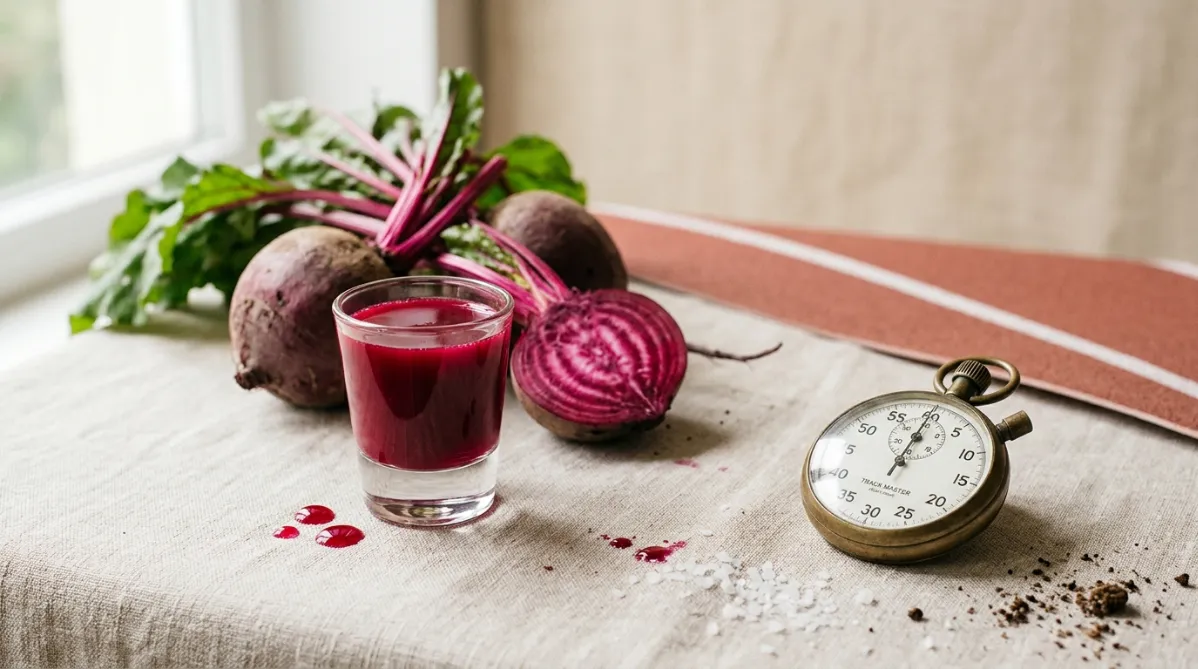
A wide editorial still life on a clean, pale oatmeal-colored linen surface, lit by soft natural window light from the left. In the center-left, a small clear glass shot glass filled with deep magenta-crimson beetroot juice catches a glowing highlight, with a few droplets beaded on the surface beside it. Behind it sit two whole beetroots with their leafy stems, the skins a dusty burgundy and the stems a vivid pink-red, and one beetroot sliced in half to reveal concentric rings of magenta and soft pink. To the right, a vintage-style brass stopwatch rests at an angle on the linen, its white face crisp and its hands frozen, slightly out of focus in the foreground edge. A faint curve of a sprinting track lane, in muted terracotta with thin white lines, sweeps diagonally across the blurred background, hinting at a running track without showing any people. Scattered across the surface are a few small, delicate beet-colored splashes and a light dusting of coarse sea salt. The palette is restrained and modern: warm cream, terracotta, dusty rose, deep magenta, and touches of sage green from the leaves. Shallow depth of field and a gentle film-like grain give it a contemporary lifestyle-magazine feel. The composition leaves generous negative space on the upper right for title overlay. Minimalist, tactile, calm, and sophisticated, in the style of a high-end health and science journal's editorial photography, 16:9 landscape.
nutrition

Le jus de betterave a multiplié le nitrite par 35, mais les sprinteurs ne sont pas plus rapides

BY DR. GYMBRO ·

Le jus de betterave a fait augmenter le nitrite salivaire d’environ 35 fois chez des sprinteurs entraînés, ce qui aurait pu sembler miraculeux. Mais le chronomètre n’a pas suivi. Dans une étude randomisée, en double‑aveugle et contrôlée par placebo, menée sur 12 sprinteurs masculins, une dose de 70 mL de jus de betterave n’a pas amélioré les temps sur 60 m ou 100 m, la hauteur de saut, ni la plupart des mesures de fonction musculaire. Voici ce qui a été testé, ce que l’étude ne permet pas d’affirmer, et pourquoi il vaut mieux garder son argent.
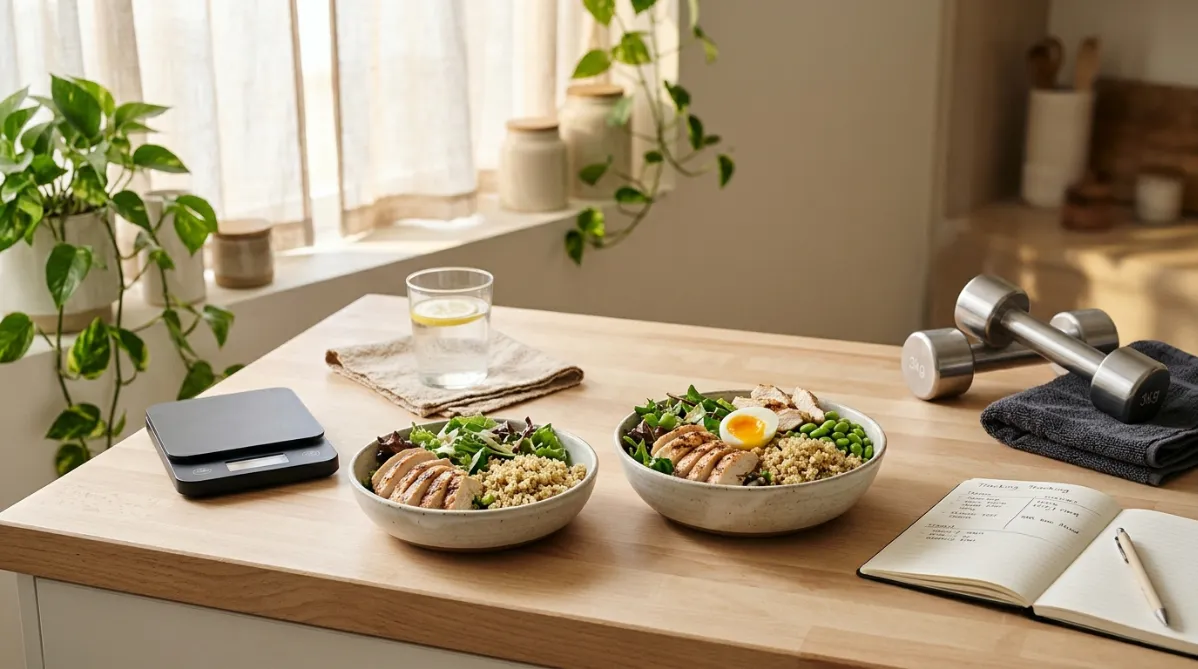
A wide landscape editorial photograph of a clean, sunlit kitchen counter in soft natural morning light, styled like a modern wellness journal cover. In the foreground, two matching ceramic bowls sit side by side on a pale oak butcher block. The left bowl holds a modest portion of sliced grilled chicken breast, quinoa, and greens. The right bowl holds a noticeably larger, double-sized portion of the same ingredients, with extra chicken, a soft-boiled egg, and edamame. The contrast in portion size is clear but elegant. Beside the bowls are a matte black digital kitchen scale, a tall glass of water with a lemon slice, and a small linen napkin in warm oatmeal tone. A pair of sleek brushed-steel dumbbells rests slightly out of focus on the counter's edge, and a folded charcoal gym towel sits next to them. In the soft-focus background, a large window with sheer curtains lets in diffused golden light, and a trailing green pothos plant adds an organic touch. A small, minimal notebook with a pen lies open to the side, suggesting careful tracking. The color palette is muted and cohesive: warm creams, sage green, soft terracotta, charcoal, and natural wood. Shallow depth of field, crisp focus on the bowls, gentle shadows, and subtle film-like grain. Composition follows the rule of thirds with generous negative space on the upper right for headline text. The mood is calm, thoughtful, and trustworthy, like a contemporary health and science magazine feature. There are no people, no text, and no futuristic elements.
nutrition

3,2 g/kg de protéines pendant 16 semaines : cela a-t-il endommagé les reins des pratiquants ?

BY DR. GYMBRO ·

Manger le double de protéines recommandé chez les adeptes de musculation pourrait-il nuire à leurs reins ? Une étude randomisée de 16 semaines, menée sur 44 hommes entraînés, a comparé 3,2 g/kg à 1,6 g/kg. Aucun marqueur rénal n’a montré de différence statistiquement significative, que les participants pratiquent uniquement de la musculation ou un entraînement mixte avec du cardio. En revanche, les groupes à forte teneur en protéines ont présenté de modestes hausses du BUN et de la cystatine C, ainsi qu’une légère baisse de l’eGFR, que les auteurs qualifient de « descriptif uniquement ». Voici ce que cela signifie, ce que l’étude ne peut pas conclure, et pourquoi il faut rester prudent.
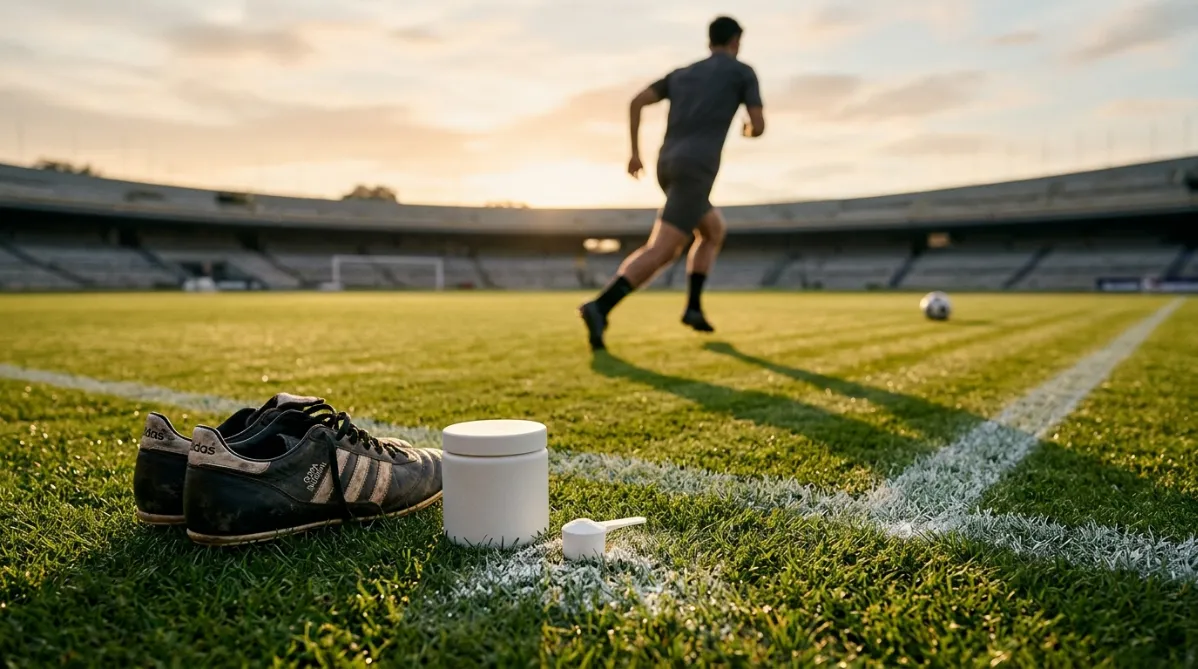
A wide, editorial-style photograph of a soccer pitch at golden hour, shot from a low angle at the edge of the touchline. In the foreground, a pair of worn leather cleats sits beside a small, matte white scoop and a minimalist ceramic jar of fine white powder resting on the dewy grass. A few loose grains of powder dust the blades of grass and catch the warm light. The jar is unbranded, with a clean, modern look.

In the midground, slightly out of focus, a lone player in a plain charcoal training kit stands mid-stride on the pitch, caught in a sprint. The motion blur in the legs suggests speed, and long shadows stretch across the freshly mowed stripes of the turf. A soccer ball rests a few meters ahead of the player.

Behind them, the stadium stands curve softly into the distance, rendered in a hazy, muted gradient of peach, soft amber, and pale blue sky. The mowing pattern on the grass forms clean diagonal lines that lead the eye toward the horizon. A thin white chalk line cuts across the frame, adding a subtle graphic element.

The palette is warm and restrained: sage and deep green grass, cream white, soft apricot light, and touches of charcoal. The mood is calm, thoughtful, and slightly skeptical rather than hyped, like a magazine feature on sports science. Shallow depth of field with a creamy bokeh background, fine film grain, and gentle natural contrast. The composition follows the rule of thirds, with the jar and cleats in the lower left and open negative space in the upper right, which leaves room for a headline overlay. The look is contemporary and clean, like a premium health and performance journal.
nutrition

Créatine pour le football : 41 études, une vérité gênante sur les sprints

BY DR. GYMBRO ·

La créatine est omniprésente, et les exigences riches en sprints du football laissent penser qu’elle serait faite pour ce sport. Une nouvelle revue systématique de 41 études a mis à l’épreuve cette hypothèse et a rendu un verdict plus prudent que le marketing ne le laisse croire. Certaines études ont montré des bénéfices sur les sprints répétés, la puissance anaérobie et la force, mais les preuves restent incohérentes et de très faible certitude. Les allégations de récupération ont reçu peu de soutien, et le poids corporel a souvent augmenté sans gain net de masse maigre. Voici ce qu’il faut retenir, qui pourrait en profiter et qui devrait y réfléchir à deux fois.
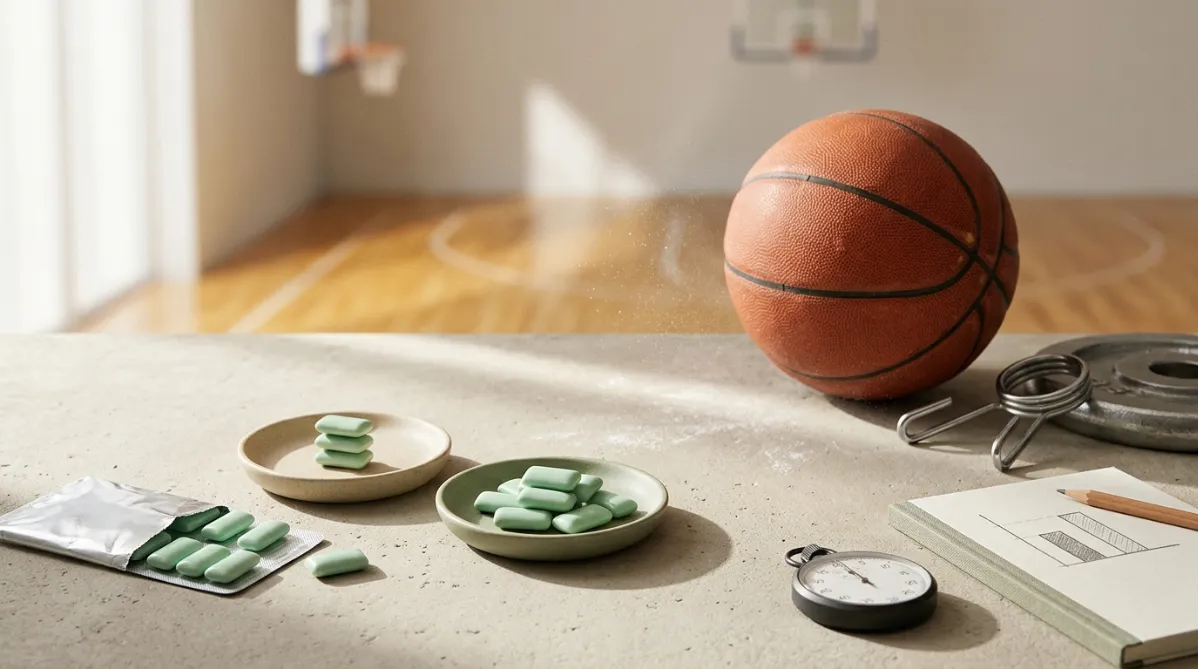
A landscape editorial still life on a pale warm-gray concrete surface, shot from a slightly elevated three-quarter angle in soft diffused morning window light. In the foreground left, a small open foil blister pack of mint-green caffeine gum sits beside two neatly arranged piles of gum pieces, one with three pieces and one with six, each on a small matte ceramic dish in oat and sage tones. The pieces are slightly glossy, rounded rectangles with crisp shadows. In the center-right, a worn leather basketball rests on the surface with deep amber-orange tones and visible pebbled texture. Next to it is a loosely chalked barbell collar and a single steel weight plate edge, partly out of focus. A minimalist analog stopwatch with a matte white face and a thin black hand lies at the lower right, and a slim notebook with a pencil rests nearby. The page shows a simple hand-drawn bar graph of two equal bars, with no legible text. In the soft-focus background, a blurred indoor basketball court with warm honey-colored hardwood and distant hoop lines fades into creamy bokeh. A narrow band of sunlight crosses the scene diagonally and picks out chalk dust particles in the air. The palette is muted and modern: sage green, warm oat, terracotta orange, charcoal, and cream. The composition leaves open negative space on the upper left for title overlay. Shallow depth of field, fine film grain, and a calm, clean magazine aesthetic like a contemporary health and science journal. No people, no text, no futuristic elements.
science research

Gomme à caféine et performance le jour même : pourquoi 3 mg/kg ont égalé 6

BY DR. GYMBRO ·

Une nouvelle étude croisée publiée dans le *Journal of the International Society of Sports Nutrition* montre que la gomme à caféine à 3 mg/kg améliore la force, la puissance, la vitesse de sprint et l’agilité réactive le jour même, presque autant qu’une dose de 6 mg/kg. Les deux doses ont également accru la vitesse de la barre pendant le « priming » du squat lourd. Au bout de 24 à 48 h, l’avantage avait complètement disparu. L’étude ne comportait ni test de référence préalable ni groupe ne recevant que de la caféine, ce qui impose une lecture prudente des résultats. Voici ce que cela implique en termes de dose, de timing et de publics susceptibles d’en profiter.

A wide, editorial-style still life photographed on a pale warm-gray concrete surface in soft, diffused morning window light. On the left side, a tall clear glass filled with deep magenta-crimson beetroot juice sits beside two halved raw beetroots, their concentric rings of vivid fuchsia and purple clearly visible, with a few small green-and-red-veined leaves draped casually nearby. On the right side, a matching clear glass of cloudy white creatine solution rests next to a small matte ceramic bowl heaped with fine white powder and a minimal wooden scoop, a light dusting of powder scattered across the surface. In the center, between the two sides, a simple matte black barbell grip and a single chalk-dusted weight plate edge rise into the frame at a low angle, hinting at lifting without showing a person. The composition is split in a balanced, symmetrical way, with a subtle vertical shadow line dividing the saturated magenta tones on the left from cool, neutral whites and creams on the right. The background is softly blurred with a muted sage-green and oatmeal-toned wall, with plenty of negative space at the top for a headline overlay. Shallow depth of field, crisp focus on the glasses' condensation droplets and the textured beetroot flesh. The color palette is limited and refined: magenta, cream, charcoal, and soft sage. The mood is clean, modern, and health-journal chic, like a contemporary wellness magazine cover, with natural shadows, a tactile matte finish, and subtle film-like grain. No text, no logos, no futuristic elements.
nutrition

Jus de betterave vs créatine : qui gagne pour la musculation en 72 heures ?

BY DR. GYMBRO ·

Un essai randomisé en croisé a opposé le jus de betterave à la créatine pendant environ 72 heures de supplémentation chez des haltérophiles novices. La créatine a permis davantage de répétitions au développé couché à 80 % du 1RM, tandis que le jus de betterave s’est démarqué sur la vitesse de la barre, l’oxygénation musculaire, le pic de fréquence cardiaque et la récupération mesurée par la variabilité du rythme cardiaque. Le résumé ne précise ni les doses ni le timing, d’où ces lacunes. Voici le tableau complet et les profils susceptibles de privilégier chaque supplément.
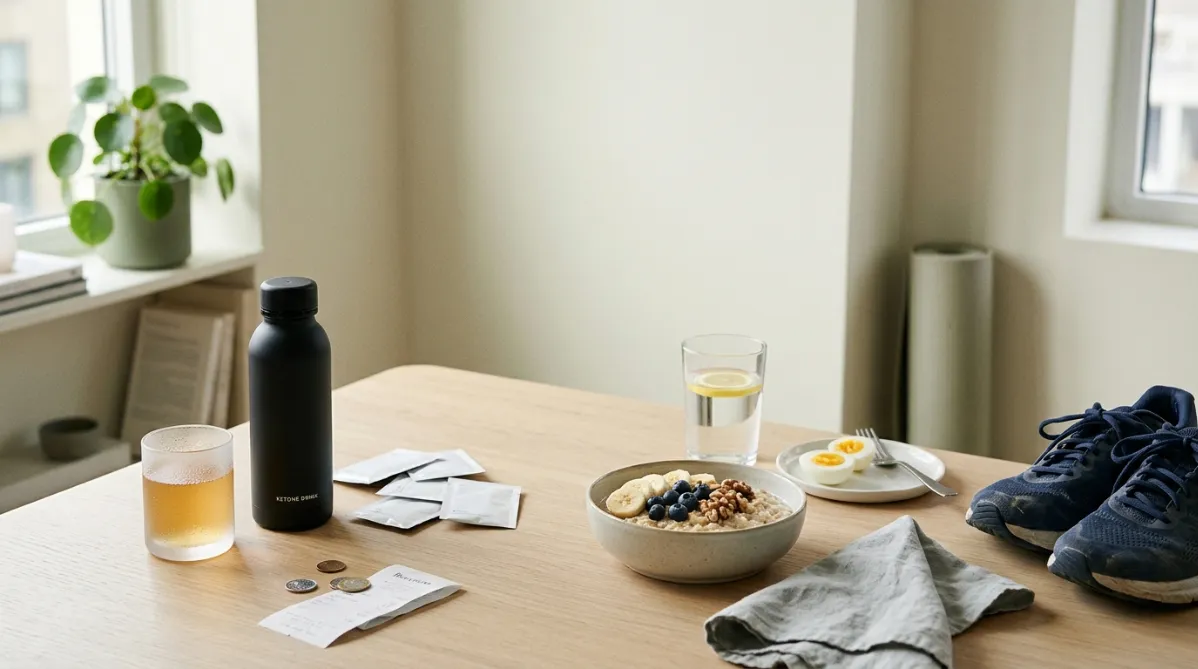
A calm, editorial still life photographed from a slightly elevated angle on a pale oak table in soft morning window light. On the left, a sleek matte-black single-serve ketone drink bottle with a minimal label stands next to a small frosted glass filled with a pale amber liquid, with a few condensation droplets on its surface. A modest scatter of small unmarked white sachets lies beside it, hinting at a pricey supplement habit. On the right, a thoughtfully arranged group of simple, proven recovery staples: a ceramic bowl of oatmeal topped with sliced banana and blueberries, a tall glass of water with a lemon slice, a boiled egg halved on a small plate, and a folded soft gray linen towel. A pair of well-worn running shoes rests casually at the edge of the frame, with a neatly rolled yoga mat leaning against the wall behind them. In the background, a softly blurred sunlit corner of a modern apartment shows a green potted plant and a cream wall. A few coins and a crisp folded receipt sit near the ketone bottle, a subtle nod to the cost question.

The palette is muted and earthy, with warm creams, sage green, soft charcoal, and touches of amber and berry blue. The light is diffused and natural, with gentle long shadows and shallow depth of field that keeps the foreground objects crisp. The composition is balanced with generous negative space across the top third for headline overlay, and the mood is thoughtful, grounded, and quietly skeptical. The look is a modern lifestyle magazine photograph, clean and minimal, with fine film-like grain and a trendy wellness-journal feel. Landscape 16:9 format.
recovery

Les boissons cétoniques valent‑elles le coup pour la récupération ? Les données disent probablement non

BY DR. GYMBRO ·

Les boissons cétoniques sont souvent présentées comme un raccourci pour accélérer la récupération, mais une revue systématique et méta‑analyse exploratoire récente n’a trouvé que peu de preuves pour étayer cette promesse. Comparées à un placebo, les cétones exogènes n’ont montré aucun bénéfice significatif sur les courbatures, la resynthèse du glycogène, la créatine kinase ou la performance physique. Le lactate post‑exercice a même légèrement favorisé le groupe témoin, et les seules améliorations observées concernaient le temps de réaction. Les données proviennent majoritairement d’hommes actifs, ce qui limite la généralisation. Voici ce que cela implique pour votre portefeuille et quelles alternatives privilégier.
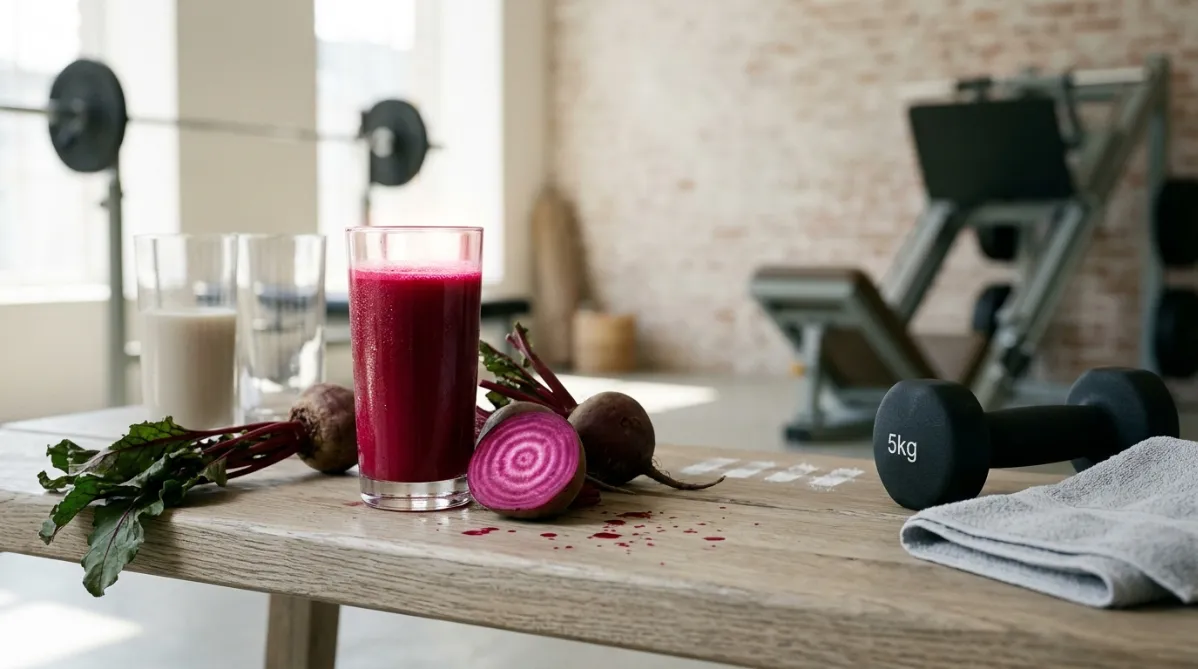
A wide, editorial-style still life photographed in soft natural window light, set on a pale oak gym bench or a light concrete surface. In the center foreground, a tall clear glass of deep magenta-crimson beetroot juice catches the light, with a faint luminous glow along its rim and condensation beading on the outside. Two other glasses sit slightly behind it, one holding a pale, neutral-colored liquid and one empty. They suggest the placebo and no-treatment conditions without any labels. Beside the glasses, a halved raw beetroot shows concentric rings of vivid fuchsia and violet. A few whole beets with their leafy stems and dark green and burgundy leaves are scattered casually nearby.

On the right side of the frame, slightly out of focus, a matte black women's-size dumbbell and a neatly folded light gray towel rest on the bench. Behind them, the soft blur of a minimalist, airy training space includes a barbell rack and a leg press machine in muted tones. The background is bright and neutral, in warm off-white, soft sand, and light gray, so the magenta of the juice is the dominant accent color.

A small, restrained motif of four evenly spaced chalk marks or four small round weight plates arranged in a neat row on the bench hints at the "four sets" of the trial. A few drops of beet juice have splashed onto the surface, forming a tasteful organic pattern.

The composition follows the rule of thirds, with the glass of juice on the left third and open negative space on the right for headline text. Shallow depth of field, crisp focus on the glass and beet, subtle film-like grain, and a calm, modern, trendy magazine aesthetic. The palette is magenta, deep burgundy, sage green, cream, and soft gray. The mood is quiet, skeptical, and scientific without any laboratory imagery, with clean lines and an elegant, minimal feel.
supplements

Le jus de betterave n’augmente aucune répétition chez les femmes entraînées en résistance

BY DR. GYMBRO ·

Le jus de betterave est souvent présenté comme un stimulant naturel des répétitions, mais une étude randomisée, en double‑aveugle et croisée, menée chez des femmes pratiquant la musculation n’a montré aucun bénéfice. Seize participantes ont consommé du jus riche en nitrate (12,8 mmol), un placebo ou rien avant quatre séries de développé couché et de presse à cuisses jusqu’à l’échec. Le nombre total de répétitions, l’effort perçu, la fréquence cardiaque, la pression artérielle et le lactate n’ont pas varié de façon statistiquement significative. Ces résultats n’infirment pas définitivement le jus de betterave, mais ils suggèrent que son effet ergogénique pourrait être limité pour cette population et ce protocole.
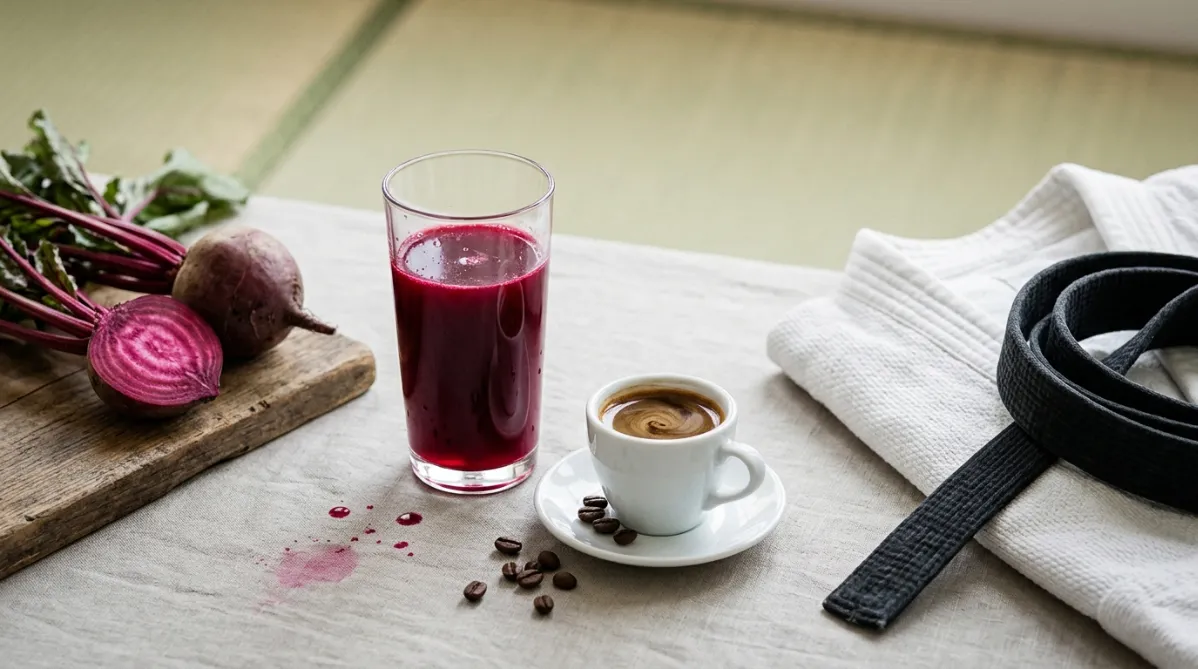
A wide landscape editorial still life on a pale warm-gray linen surface, shot from a slightly elevated three-quarter angle in soft diffused morning window light. At center-left, a tall clear glass filled with deep magenta-crimson beetroot juice catches the light, its edges glowing ruby with a few condensation droplets on the surface. Beside it sits a small white ceramic espresso cup with dark, glossy coffee and a delicate swirl of crema. A few roasted coffee beans are scattered casually near the cup's saucer. To the left, two whole raw beetroots with their leafy burgundy-veined greens still attached rest on a rustic wooden board, with one beet sliced in half to reveal concentric rings of vivid fuchsia and pale pink. A folded white judo gi sleeve with a worn black belt loosely coiled on top is draped along the right side of the frame, the cotton weave texture visible, hinting at the sport without any people. In the background, a soft-focus tatami mat texture in muted straw-green creates a subtle horizontal band, blurred into creamy bokeh. A small scattering of beet juice droplets and a faint magenta stain on the linen add an organic, lived-in touch. The palette is restrained and modern: magenta, espresso brown, off-white, muted sage, and warm beige. Composition leaves generous negative space on the upper right for headline overlay. The mood is clean, calm, and contemporary, like a premium health and science magazine cover, with shallow depth of field, crisp focus on the glass and cup, fine natural shadows, and subtle film-like grain.
nutrition

Jus de betterave + caféine : la combinaison du judo qui dépasse la caféine seule

BY DR. GYMBRO ·

La caféine est le stimulant de prédilection avant un combat, mais une nouvelle étude randomisée menée auprès de 35 judokas montre que son avantage s’estompe dès le cinquième round d’une journée de compétition simulée. Le jus de betterave, en revanche, apporte un bénéfice tardif, et la combinaison des deux couvre les performances du début comme de la fin. Au cinquième test, le jus de betterave seul et le mélange ont surpassé la caféine seule en termes de forme spécifique au judo, de fonction neuromusculaire et de cognition. Voici ce que l’étude révèle, à qui elle peut être utile, qui doit rester prudent et ce que le résumé ne mentionne pas.
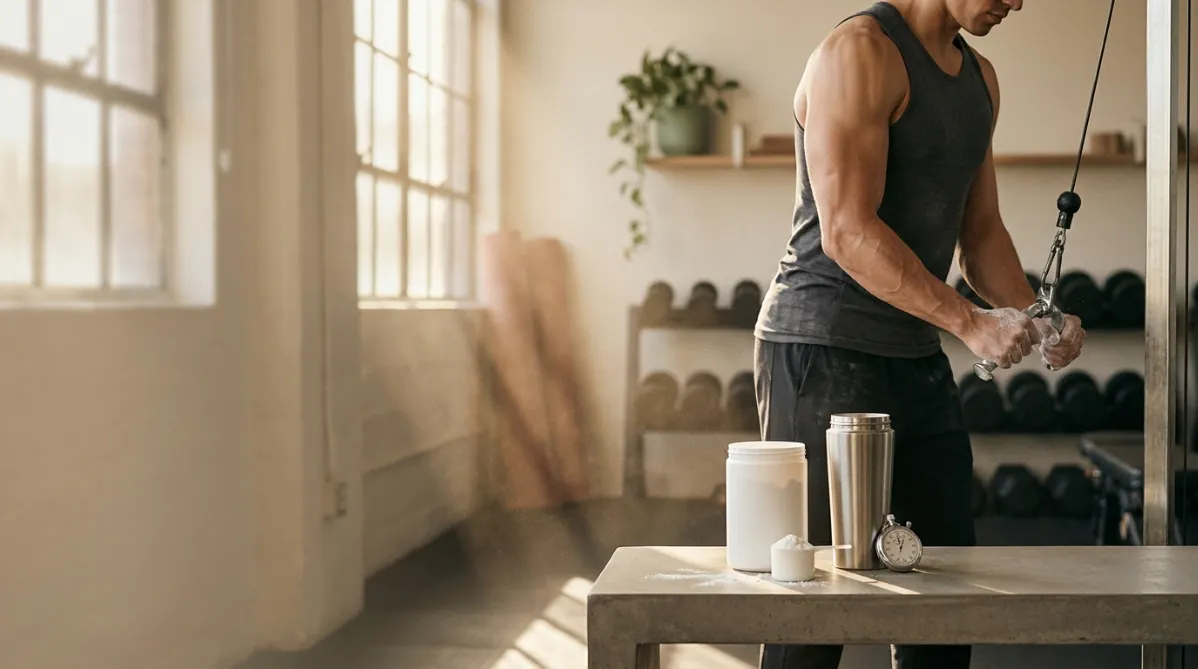
A softly lit, minimalist gym interior photographed in a modern editorial style. In the foreground, a muscular lifter in a fitted charcoal tank top is mid-set at a cable station, forearm and shoulder muscles defined, a light dusting of chalk on their hands. The frame is shot at a slight low angle with shallow depth of field, so the background gym equipment melts into creamy blur. On a matte concrete-textured bench beside them sits a clean, unbranded matte-white scoop container of white powder, a stainless steel shaker bottle, and a small analog stopwatch, arranged with careful, magazine-style composure. A few loose grains of white powder catch the light on the bench surface.

Warm golden late-afternoon sunlight pours through tall industrial windows on the left, creating long diagonal light streaks, gentle lens flare, and a subtle haze of floating chalk dust that glows in the beams. The palette is restrained and sophisticated: warm sand, soft cream, muted terracotta, deep charcoal, and a single accent of sage green from a potted plant on a shelf. Rows of neatly racked dumbbells in dark metal repeat in the mid-ground, adding rhythm and depth.

The composition follows the rule of thirds: the lifter and supplement still life occupy the right two-thirds, while the left third remains calm, with a smooth, softly blurred wall and window light, leaving generous negative space for headline text. Subtle film grain, natural color grading, and a slightly desaturated, high-end lifestyle photography look evoke a contemporary health and science journal. No text, logos, or graphics. Clean, aspirational, grounded, and tactile, with a sense of focused effort and quiet intensity.
nutrition

La bêta‑alanine fonctionne enfin pour les haltérophiles — si vous vous entraînez ainsi

BY DR. GYMBRO ·

La bêta‑alanine a longtemps fait couler des avis mitigés en musculation, mais une nouvelle étude randomisée contrôlée pourrait en éclaircir les raisons. Quand des pratiquants entraînés ont pris 6,4 g par jour pendant quatre semaines, leurs répétitions totales ont augmenté de 17,3 % sur les drop‑sets et de 18,2 % sur les bi‑sets, alors que le groupe placebo n’a montré aucune amélioration significative. La perception de l’effort, la motivation et l’humeur restent inchangées, ce qui indique que le gain était purement physique. Voici la dose, la période de charge, à qui ces données s’appliquent et qui devrait rester sceptique.
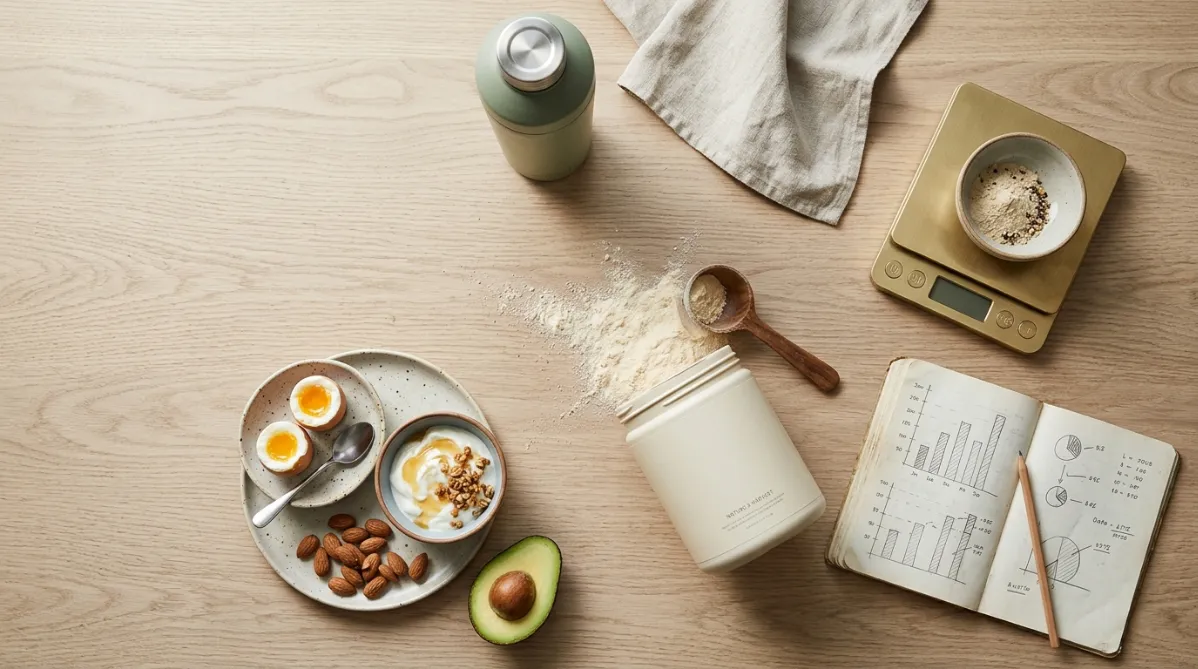
A wide, editorial-style flat lay shot from directly above on a pale oak table in soft morning window light. At the center, an open matte cream-colored protein powder tub sits tipped slightly, with a wooden scoop resting beside it and a small, elegant dusting of fine powder spilling across the wood grain. To the left, a neat balanced arrangement of whole foods: two soft-boiled eggs in a ceramic dish, a small bowl of Greek yogurt with a drizzle of honey, a handful of almonds, and a halved avocado. To the right, a minimalist brass kitchen scale holding a small ceramic bowl, with a handwritten notebook page beside it showing simple pencil-drawn bar charts and a few scribbled numbers, no legible text. A matte shaker bottle in muted sage green stands near the top edge, along with a folded linen napkin in warm oatmeal tone. The color palette is restrained and modern: warm creams, soft sage, terracotta accents, and natural wood, with gentle diffused shadows and subtle film-like grain. Composition leaves generous negative space on the left third of the frame for headline overlay. The mood is calm, thoughtful, and quietly skeptical, like a contemporary health and science magazine cover. Shallow depth of field, crisp textures on powder and ceramic, high-end lifestyle photography, clean and uncluttered.
nutrition

Le secret sale de la poudre de protéines : les gains disparaissent quand les calories sont équilibrées

BY DR. GYMBRO ·

La poudre de protéines améliore‑t‑elle réellement vos performances et votre récupération, ou consommez‑vous simplement plus de calories ? Une méta‑analyse bayésienne de 75 essais randomisés portant sur 1 206 athlètes a mis en évidence des bénéfices réels mais modestes. Le point crucial : chaque résultat statistiquement significatif provenait d’études où l’apport énergétique n’était pas équilibré entre les groupes. Le conseil le plus concret de l’article porte sur le dosage : environ 1 g / kg / jour supplémentaire grâce aux compléments, pour un total d’environ 2 g / kg / jour. Voici ce que les données soutiennent, ce qu’elles ne disent pas sur le timing et la source de protéine, et qui peut se passer de la boîte.
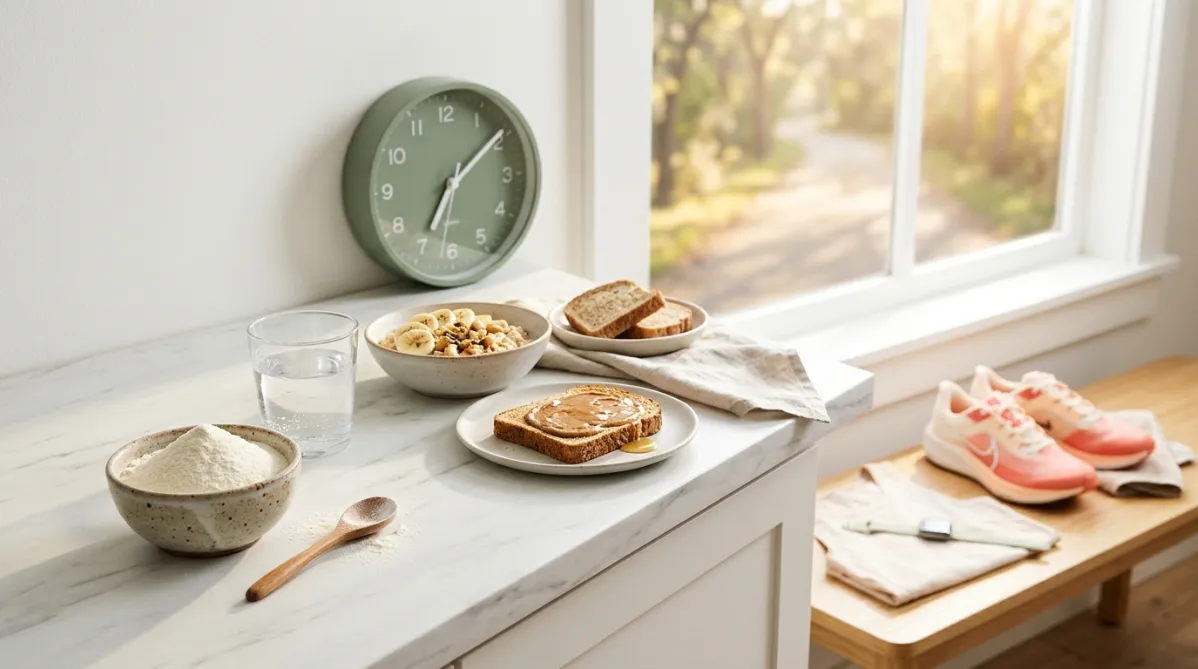
A bright, airy editorial photograph in landscape format of a clean white marble kitchen counter in soft morning light. On the left, a small rustic ceramic bowl holds a mound of fine white powder, with a wooden spoon resting beside it and a scattering of powder dusted across the marble. Next to it sits a glass of water with a faint ripple on its surface. In the middle ground, a simple breakfast spread: a bowl of oatmeal topped with sliced banana, a piece of toast with honey, and a few slices of white bread, all styled in muted, natural tones. A minimalist analog wall clock or a vintage round kitchen timer in matte sage green sits subtly in the background, hinting at the 90-minute timing.

On the right side of the frame, slightly out of focus, a pair of modern running shoes in soft coral and cream rests on a light oak floor or bench. Next to them are a folded running shirt and a slim sports watch. Through a large window behind the counter, a blurred sunlit tree-lined running path glows in warm golden light, suggesting a woman's morning run without showing a face.

The palette is soft and modern: warm whites, sage green, pale peach, light wood, and touches of coral. Shallow depth of field, gentle natural shadows, and a clean composition with generous negative space in the upper left for title overlay. The mood is fresh, trustworthy, and health-journal chic, like a high-end wellness magazine feature. Shot on a 50mm lens, crisp details, subtle film grain, and a calm, minimal, contemporary feel.
nutrition

Le bicarbonate de soude fait gagner 32 secondes aux femmes sur le 10 km – le piège

BY DR. GYMBRO ·

Un composé bon marché du garde‑manger a permis aux coureuses amateurs de gagner environ 32 secondes sur un 10 km, et les troubles gastriques qui l’accompagnent habituellement sont à peine apparus. Dans un essai croisé en double‑aveugle, 21 femmes ont couru plus vite après avoir pris du bicarbonate de sodium. Le truc ? L’associer à un repas riche en glucides 90 minutes avant la course. Voici le dosage, le timing, à qui cela convient et qui devrait y réfléchir à deux fois.
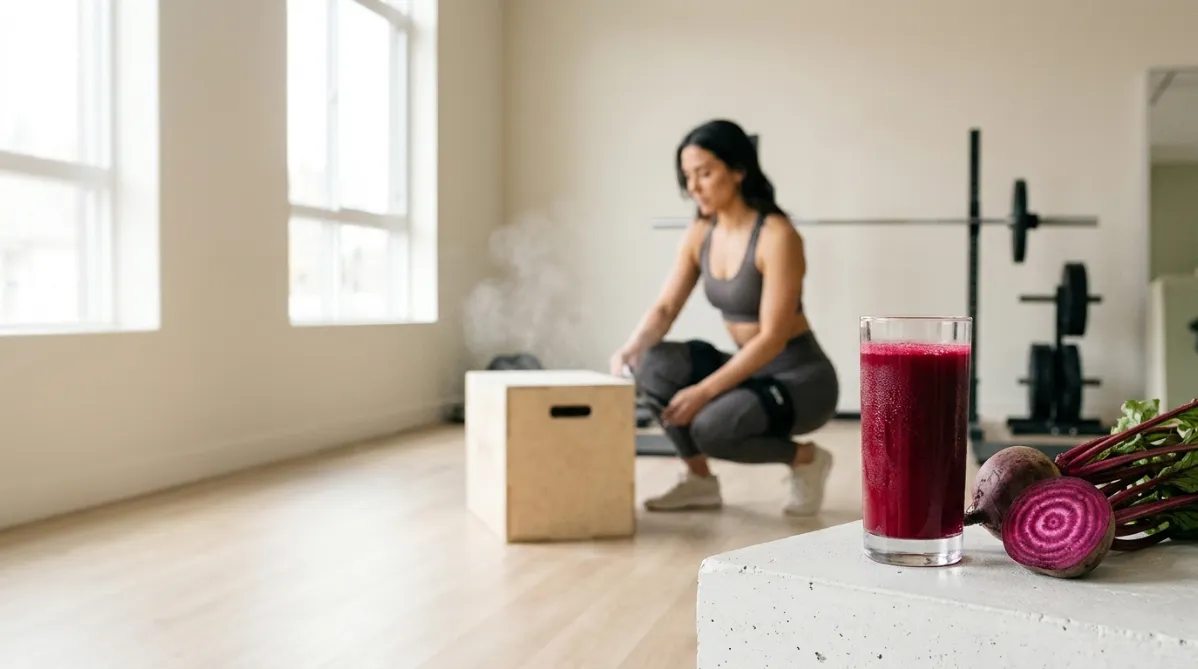
A bright, modern editorial photograph of a minimalist athletic studio with pale oak flooring and soft diffused daylight pouring in from tall windows on the left. In the foreground, slightly off-center to the right, a tall glass of deep magenta-crimson beetroot juice sits on a matte white concrete surface, condensation beading on the glass, a few fresh whole beets with leafy stems and one halved beet showing vivid concentric purple rings arranged beside it. Behind them, softly blurred with shallow depth of field, an athlete in neutral-toned athletic wear (charcoal and cream) crouches mid-prep, with slim black blood flow restriction cuff bands wrapped around the upper thighs. A clean wooden plyo box and a simple barbell rack are subtly visible in the background. A thin arc of chalk dust hangs in the air, suggesting a recent jump. The color palette is restrained and trendy: warm off-white, soft sage green, charcoal gray, with the beetroot magenta as the single bold accent. Composition follows a wide 16:9 landscape layout with generous negative space on the left third for title overlay. Lighting is natural, gentle, and slightly golden, with soft shadows and a subtle film-grain texture. The overall feel is a contemporary wellness and sports science magazine cover: clean, calm, sophisticated, tactile, with crisp detail on the juice and beets and a dreamy blur on the athlete.
science research

Jus de betterave et entraînement BFR : un gain de saut en fatigue, mais pas de force

BY DR. GYMBRO ·

Tout le monde pense que le jus de betterave combiné à l’entraînement en restriction de flux sanguin (BFR) augmente la force. Cette étude randomisée, en double‑aveugle, montre que les deux groupes sont devenus plus forts, mais que seul le groupe ayant consommé du jus de betterave a amélioré la hauteur du saut contre‑mouvement lorsqu’il était déjà fatigué. Le protocole utilise 8 mmol de nitrate par jour, une phase de charge d’une semaine et un programme BFR de quatre semaines. Voici à qui cela peut convenir, qui devrait éviter, et pourquoi les résultats restent préliminaires.
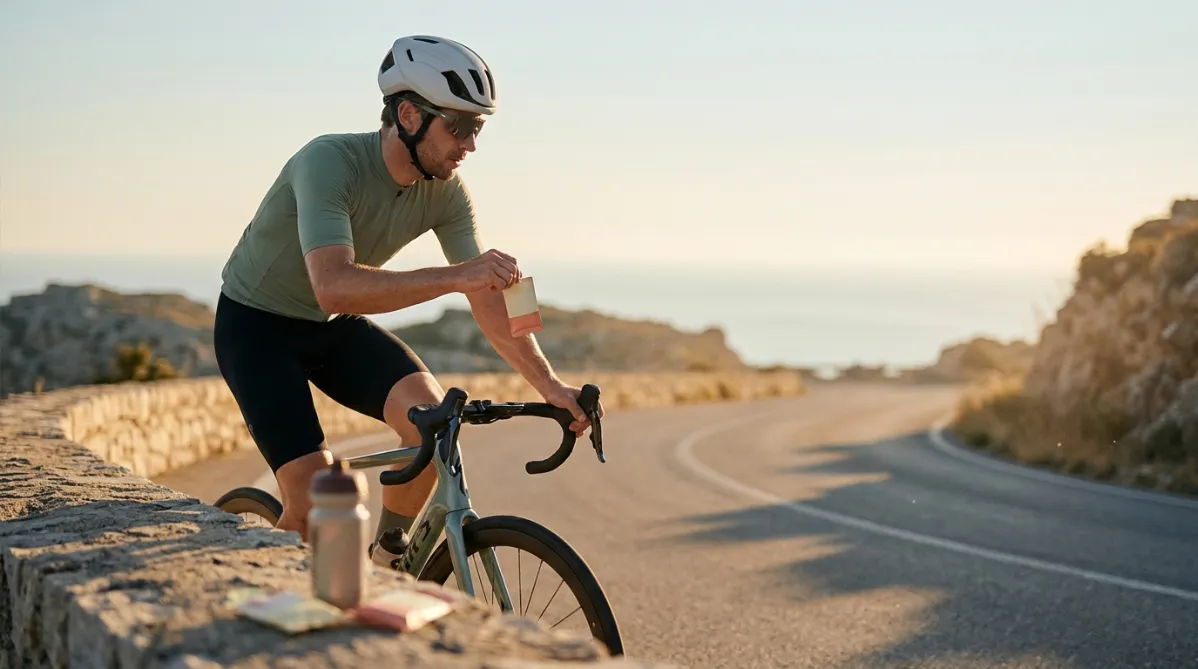
A cyclist in profile, riding a sleek road bike along a quiet coastal road in warm golden-hour light, shot from a low side angle with a shallow depth of field. The rider wears a muted sage-green jersey, black bib shorts, a matte white helmet, and sunglasses. Their face shows calm, focused fatigue, with a faint sheen of sweat on the forearms. One hand is lifted slightly from the handlebars, holding a small, unbranded matte gel packet in soft cream and coral tones, just before opening it. The road curves gently behind them toward a hazy, softly blurred horizon of pale sea and distant hills, with long amber shadows stretching across the asphalt.

In the foreground, slightly out of focus, a few gel sachets and a bike bottle rest on a weathered stone wall at the left edge of the frame, adding editorial depth. Fine dust and sunlight glow in the air. The palette is warm and restrained: butter yellow, soft peach, sage, and slate blue, with gentle film-like grain. The composition leaves open negative space in the upper right, a pale gradient sky, for headline overlay. The overall look is a modern, minimalist sports-science magazine photograph: natural, premium, and clean, with realistic textures, cinematic but understated color grading, and no text, logos, or graphics.
nutrition

Des gels contenant du bicarbonate pris en cours d'effort augmentent de 12 W la puissance lors d’un test cycliste de 3 heures

BY DR. GYMBRO ·

Et si le meilleur moment pour consommer du bicarbonate n’était pas avant la course, mais pendant ? Un essai randomisé croisé auprès de 11 cyclistes entraînés a comparé des gels au bicarbonate et aux glucides pendant trois heures de vélo. Après l’effort, la puissance moyenne sur un test de 12 minutes était supérieure de 12 W par rapport aux seuls glucides, sans différence de troubles gastriques. Aucun avantage n’a été observé sur les sprints ni sur les efforts de deux minutes, et l’échantillon reste très restreint.
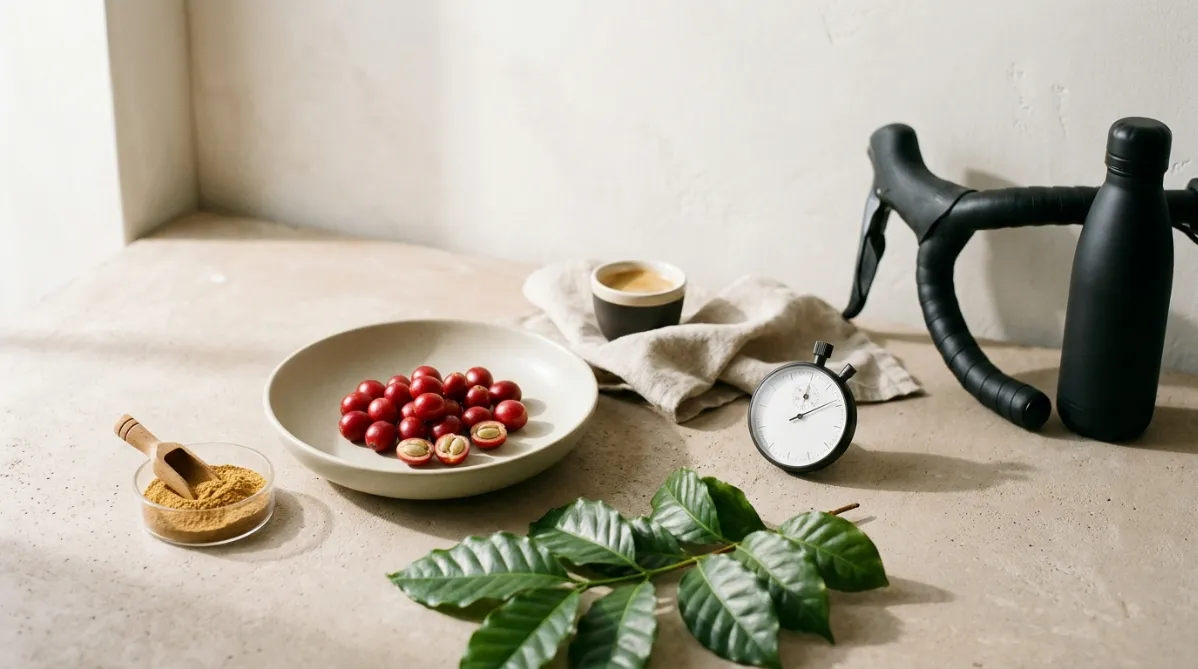
A wide editorial still life on a pale, warm-toned concrete surface in soft morning window light. In the center-left, a shallow matte ceramic bowl holds a small pile of bright red coffee cherries with glossy skins, a few sliced open to reveal pale mucilage and paired green-tan beans. Beside it, a small glass dish of fine, golden-brown powdered extract with a tiny wooden scoop resting on its edge. A sprig of coffee plant leaves, deep green and waxy, arcs across the foreground.

On the right side, slightly out of focus, a sleek road cyclist's handlebar and a matte black water bottle lean against a light plaster wall, suggesting athletic training without showing a person. A minimalist analog stopwatch with a clean white face and thin black hands sits in the mid-ground, angled toward the camera, its hands paused near the fifteen-minute mark. A folded linen cloth in oatmeal beige and a single small espresso cup with a thin crema ring add quiet texture.

The color palette is restrained and modern: cherry red, sage green, cream, soft terracotta, and charcoal accents. Light comes from the left, casting long, gentle shadows with a subtle warm glow and a hint of dust in the air. Shallow depth of field with crisp focus on the cherries and stopwatch, creamy bokeh in the background. Composition leaves open negative space in the upper right for a headline overlay. The overall feel is a clean, trendy health-and-science magazine cover: tactile, natural, minimal, and calm, shot in a 16:9 landscape frame with fine film-like grain and true-to-life tones.
nutrition

Extrait de cerise de café : 200 mg de caféine augmentent la puissance cycliste de 4,6 %

BY DR. GYMBRO ·

Une dose modeste de 200 mg de caféine provenant d’un extrait complet de cerise de café a permis à des cyclistes entraînés de produire 4,6 % d’effort supplémentaire lors d’un contre‑la‑montre de 15 minutes. En revanche, l’idée largement répandue selon laquelle cela accélérerait le rechargement du glycogène n’a pas été confirmée. Cette étude randomisée, en double‑aveugle et en cross‑over, n’a impliqué que 12 cyclistes et a été financée par l’industrie, sans groupe de comparaison à la caféine pure. Voici ce que les données montrent, ce qu’elles ne montrent pas, et qui pourrait être intéressé à l’essayer.
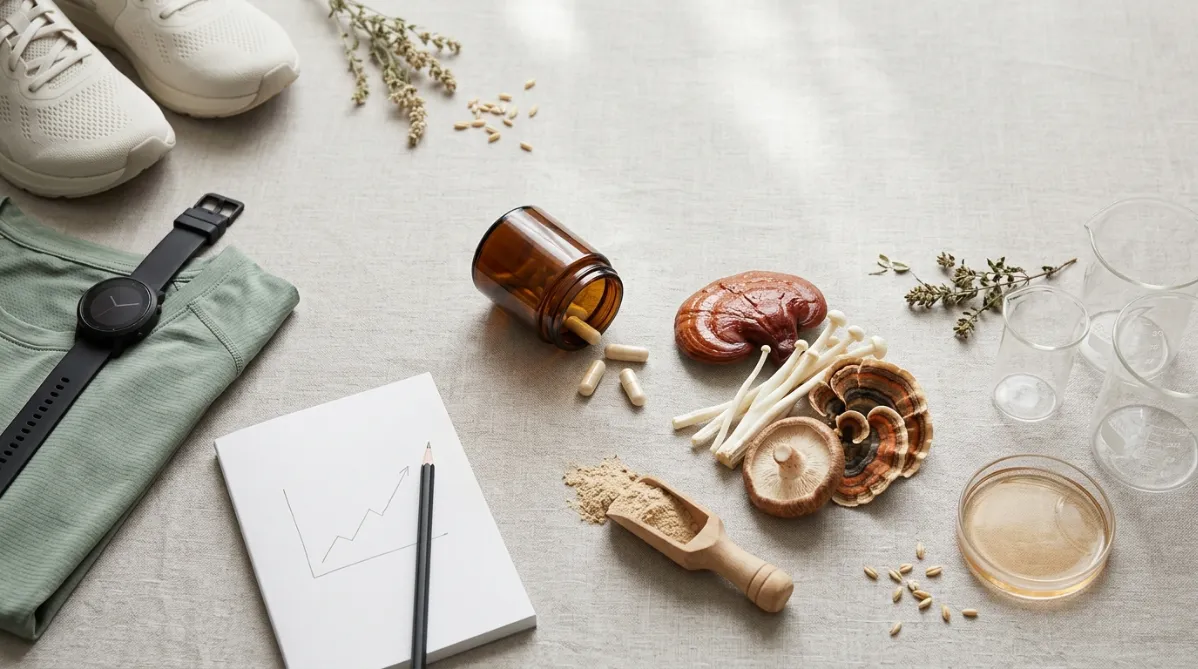
A wide, editorial-style flat lay photographed from above on a pale warm-gray linen surface in soft natural window light. At the center, a small open amber glass jar tips gently onto its side, spilling a few cream-colored capsules across the fabric. Next to the jar sits a loose arrangement of fresh mushrooms: a cluster of golden-tan reishi with glossy, lacquered caps, a few slender white enoki stems, a halved shiitake showing its pale gills, and a curl of turkey tail with concentric bands of rust, cream, and charcoal. A small wooden scoop holds a pile of fine beige mushroom powder.

On the left third of the frame, a matte black sports watch with a minimal face lies beside a folded sage-green running shirt and a pair of lightweight off-white running shoes, hinting at athletic training without showing a person. A slim white notebook with a single pencil rests nearby, open to a blank page with a faint hand-drawn line graph trending upward, in thin graphite strokes.

On the right side, a pair of clear glass beakers and a single small petri dish with a soft amber-tinted liquid add a subtle laboratory note, kept calm and organic. A single sprig of dried herbs and a few scattered oat-colored grains add texture.

The palette is earthy and refined: oatmeal, soft sage, terracotta, warm amber, and charcoal accents against the muted neutral background. Shadows are soft and diffused, with a gentle highlight on the glass and the glossy reishi cap. The composition leaves generous negative space in the upper right for a headline overlay. Shallow depth of field blurs the edges slightly, while the central mushrooms and capsules stay crisp. The overall feel is modern, clean, and trendy, like a wellness and science magazine cover, with tactile natural textures, minimal styling, and a quiet sense of curiosity and skepticism.
science research

Une capsule de champignon a augmenté le VO₂max de 14,8 % — mais il y a un gros piège

BY DR. GYMBRO ·

Une capsule de champignon, 40 jours d’utilisation et une hausse de 14,8 % du VO₂max semblent presque trop beaux pour être vrais. Dans ce nouvel article de *Antioxidants*, 50 jeunes athlètes masculins ayant pris 320 mg/jour d’un extrait multi‑champignon riche en bêta‑glucanes sont passés de 46,26 à 53,12 mL·kg⁻¹·min⁻¹. Le gros piège, c’est qu’il n’y avait ni groupe placebo, ni randomisation, ni double‑aveugle, et que les athlètes ont continué à s’entraîner pendant toute la période. Des expériences cellulaires sur des cardiomyoblastes de rat offrent un indice lié à l’hypoxie, mais elles n’ont testé que des composés isolés, pas la capsule. Voici ce que l’étude montre, ce qu’elle ne peut pas prouver, et ce que les sceptiques devraient remarquer.
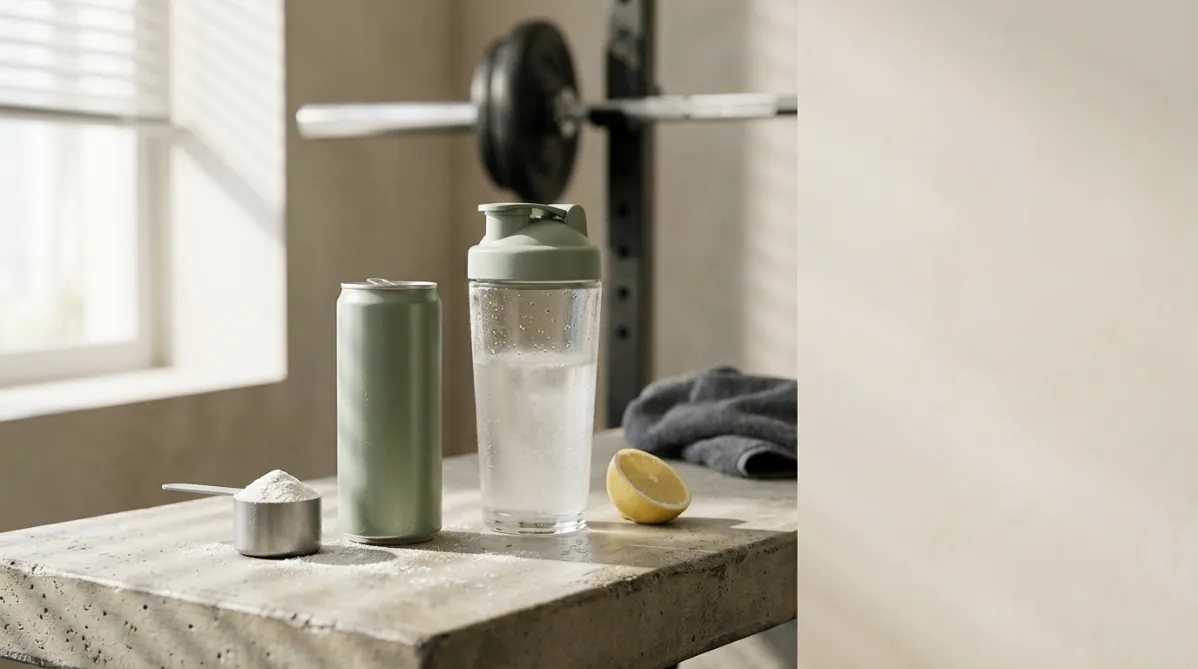
A sleek aluminum energy drink can and a matte scoop of white pre-workout powder sit side by side on a pale concrete gym bench, lit by soft morning window light. The can is slim and minimalist, with a muted sage green label and no legible text. Beside it is a clear glass shaker half full of cloudy, lightly frothy liquid with condensation beading on its surface. A few fine grains of powder are scattered across the bench, catching the light. Behind them, slightly out of focus, a stainless steel barbell rests on a rack, and a folded charcoal gym towel sits at the edge of the frame.

The color palette is warm neutral: oatmeal, soft gray, and sage, with a single accent of pale citrus yellow from a halved lemon wedge placed near the glass. A thin, elegant shadow from the window blinds falls diagonally across the scene, giving it an editorial, magazine-style rhythm. The composition leaves generous negative space on the right third of the frame, a smooth blurred wall in warm off-white, suitable for headline text overlay.

The shot is a low-angle, shallow depth-of-field product-style photograph, as if taken with an 85mm lens at f/2. The foreground objects are tack sharp and the background melts into creamy blur. The mood is calm, clean, and modern, like a wellness or science journal feature. Subtle film grain and gentle contrast add a tactile, contemporary lifestyle feel. There are no people, no logos, and no futuristic or sci-fi elements, just a quiet, considered still life that suggests the choice between a canned drink and a scooped supplement.
nutrition

Votre boisson énergétique peut agir comme un pré‑workout – mais il y a un hic

BY DR. GYMBRO ·

Caféine et taurine sont souvent associées dans les boissons énergisantes et les pré‑workouts, mais cette combinaison améliore‑t‑elle réellement la performance ? Une méta‑analyse récente de 11 essais randomisés (234 participants) montre des gains modérés en puissance maximale et en temps d’épuisement, ainsi qu’une perception d’effort moindre. Le rythme cardiaque n’a pas bougé et les résultats sur le temps de réaction restent trop variables pour être fiables. Le problème, c’est que les études sont petites et ne permettent pas de conclure que la taurine apporte quelque chose de plus que la caféine.
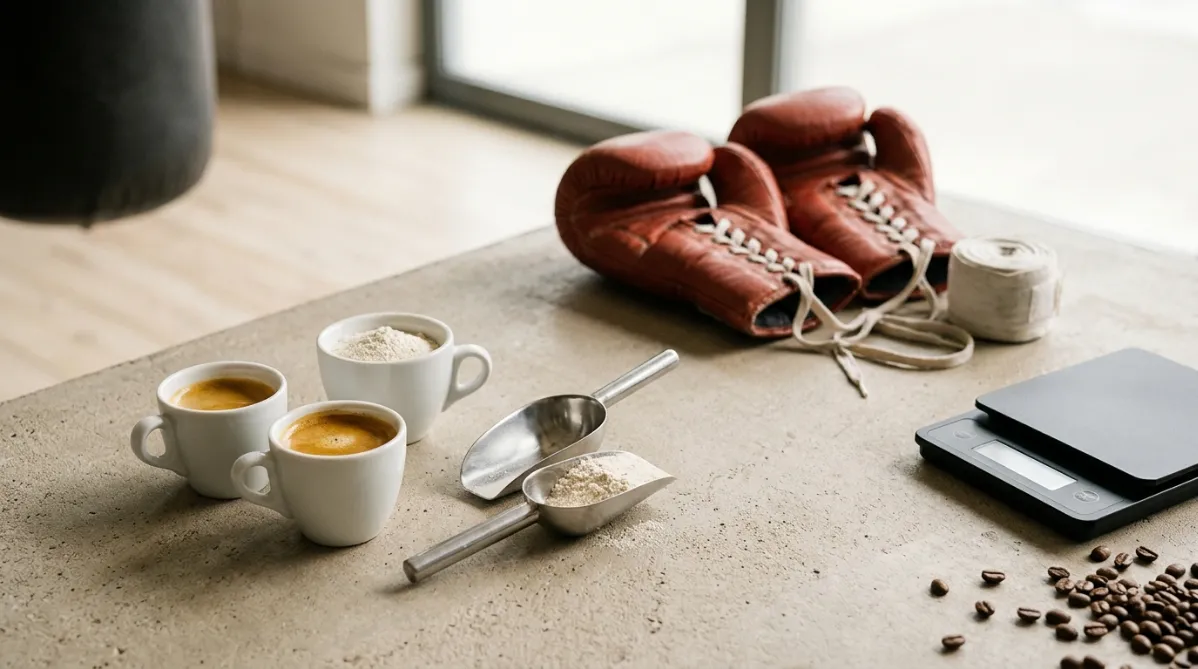
A landscape editorial photograph with a modern, clean magazine feel, shot on a pale warm-gray concrete surface in soft natural window light from the left. In the foreground, two matte white ceramic espresso cups sit side by side. The left cup holds a small amount of dark espresso with golden crema. The right cup is filled twice as high. Beside them, two small stainless steel scoops hold fine coffee-colored powder, one half full and one heaped, suggesting a dose comparison without any text or labels. A pair of worn red leather boxing gloves rests slightly out of focus behind the cups, laces loosely draped, with a white hand wrap rolled neatly beside them. A minimalist digital kitchen scale in matte black sits at the edge of the frame, with a few roasted coffee beans scattered across the surface. In the soft-focus background, a boxing gym corner appears: a hanging heavy bag in muted charcoal, pale wood plank flooring, and a tall window with diffused morning light. The palette is warm cream, espresso brown, brick red, and soft slate gray, with gentle shadows and a shallow depth of field. The composition follows the rule of thirds, with the cups and scoops in the lower left third and open negative space on the right for headline overlay. The look is tactile and refined, like a high-end health and performance journal. It has natural grain, subtle contrast, and a calm, confident mood. There are no people, no text, no logos, and no futuristic elements.
nutrition

Doubler votre caféine n’a guère aidé les boxeurs — voici ce qui a réellement fonctionné

BY DR. GYMBRO ·

Vous pensez qu’une double dose de pré‑entraînement signifie une performance doublée ? Une étude croisée menée sur 15 boxeurs de haut niveau a comparé 3 mg/kg et 6 mg/kg de caféine ; la dose la plus élevée n’a pas été systématiquement meilleure. Les deux dosages ont amélioré la hauteur du saut et la puissance à 60 minutes, tandis que 6 mg/kg ne s’est démarquée que sur quelques paramètres comme la puissance du push‑up balistique et le couple du genou. Vous trouverez ci‑dessous le tableau de conversion mg / kg, le timing recommandé et les réserves importantes, dont le fait que le coup de poing n’a jamais été testé.
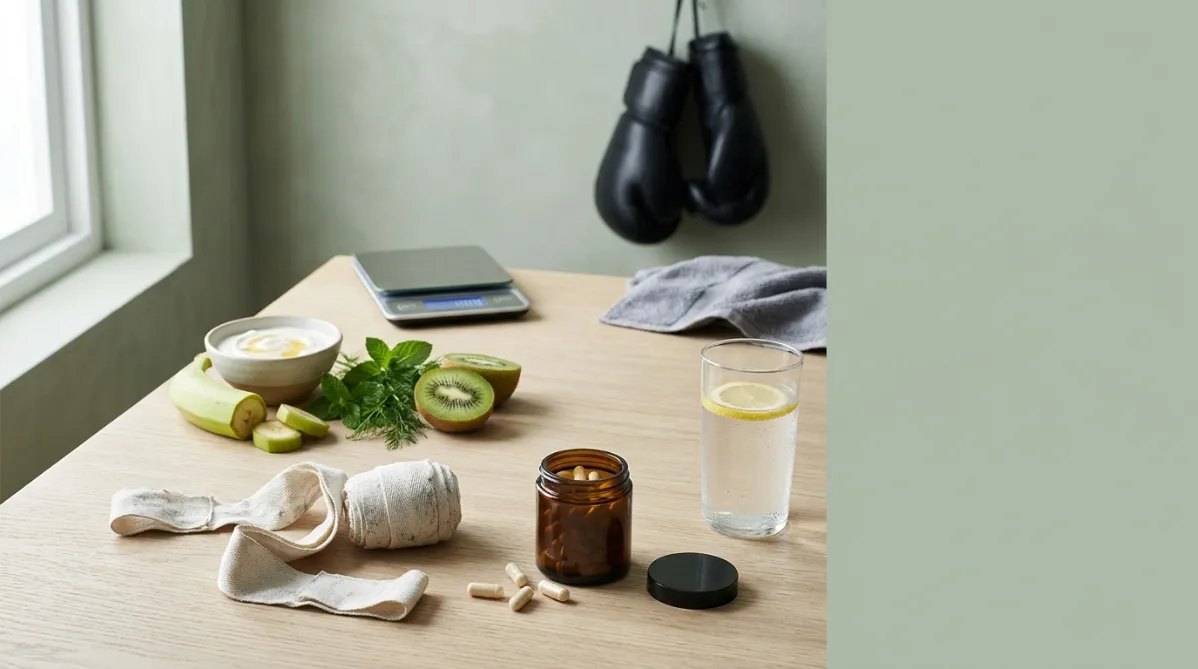
A wide, editorial-style still life photographed in soft natural window light on a pale oak table, styled like a modern wellness journal cover. In the foreground, a pair of worn white boxing hand wraps lies loosely coiled beside a small amber glass jar of probiotic capsules, its lid set to the side and a few cream-colored capsules spilled onto the wood. Next to them sits a tall glass of water with a thin slice of lemon, condensation beading on the surface. A neat bundle of fresh gut-friendly foods is arranged in the midground: a small bowl of plain yogurt with a drizzle of honey, sliced green banana, a few sprigs of fresh herbs, and a halved kiwi with glistening seeds. Behind them, slightly out of focus, a compact digital kitchen scale shows a lowered weight on its display, and a folded gray athletic towel rests beside a pair of black boxing gloves hanging from a hook against a muted sage-green plaster wall. The color palette is calm and sophisticated: sage green, warm oatmeal, soft cream, faint amber highlights, and touches of charcoal. Light streams in from the left, casting long, gentle shadows and a subtle golden glow across the textures of linen, wood, and glass. Shallow depth of field with a creamy bokeh background, crisp detail on the capsules and the hand wraps. Clean negative space on the right third of the frame leaves room for a headline overlay. The mood is fresh, restorative, and athletic, with a minimalist and refined composition, shot as if on a full-frame camera with an 50mm lens, high-end lifestyle magazine photography.
nutrition

Perdre du poids détruit votre intestin : un probiotique réduit les marqueurs de perméabilité intestinale

BY DR. GYMBRO ·

Les coupes de poids rapides avant un combat sont célèbres pour perturber la digestion, et un nouvel essai randomisé suggère qu’un probiotique pourrait aider. Chez 24 athlètes de combat masculins d’élite, quatre semaines d’un probiotique sportif complexe pris deux fois par jour ont réduit les symptômes gastro‑intestinaux et diminué la zonuline, l’I‑FABP et le D‑lactate par rapport au placebo. Le groupe probiotique présentait également un taux de SIgA plus élevé, moins d’inflammation et plus de bactéries productrices de butyrate. L’étude est petite, utilise un produit à multiples souches et ne rapporte aucune donnée de performance, ce qui rend les découvertes prometteuses mais pas définitives. Voici ce que l’essai a montré et comment les combattants pourraient l’appliquer.
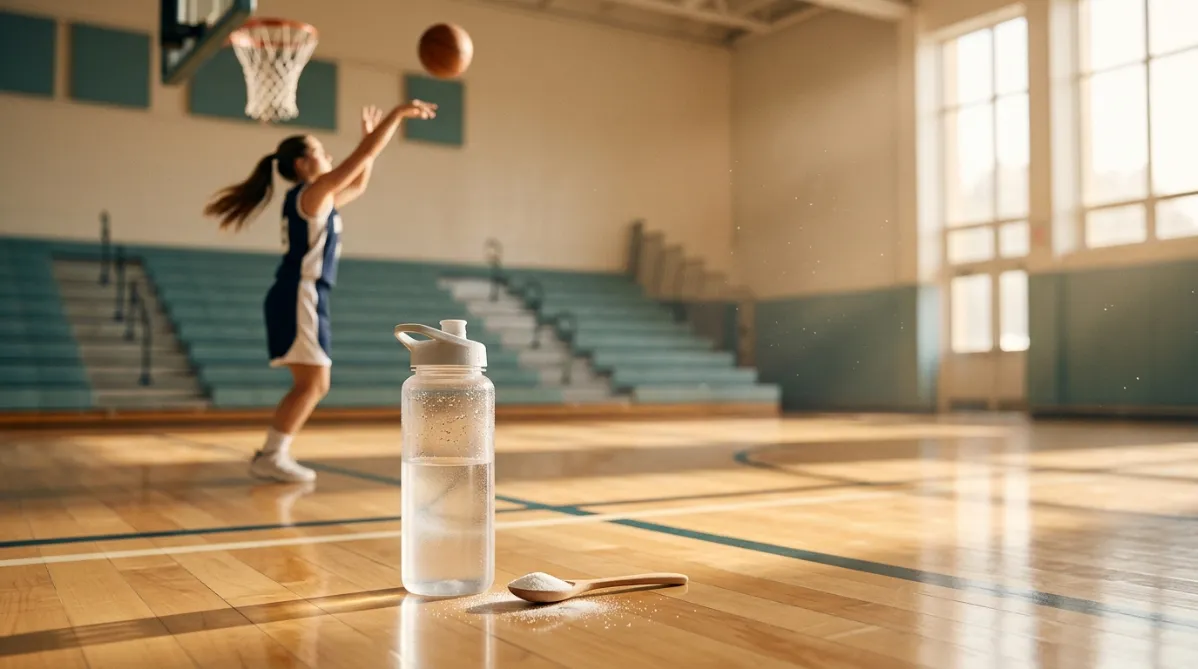
A wide, editorial-style photograph of a hardwood basketball court at golden hour, seen from a low angle near the baseline. In the foreground, slightly off-center to the left, sits a clear sports water bottle on a polished maple floor. It is half full, with tiny beads of condensation on the surface and a faint cloudy shimmer in the liquid. Beside it rests a small wooden spoon dusted with fine white powder, and a few loose grains are scattered on the wood. Warm amber light streams through tall gym windows on the right and casts long soft shadows across the court's painted lines.

In the mid-ground, slightly out of focus, a female basketball player in a navy and white uniform is caught mid-shot. Her arm is extended in a clean follow-through, her wrist relaxed, and the ball is just leaving her fingertips. Her ponytail swings behind her. Behind her, the net hangs crisp against a softly blurred bleacher background in muted teal and cream.

The palette is calm and modern: honey-toned wood, warm cream, deep navy, and soft teal accents. A shallow depth of field gives creamy bokeh in the background, with subtle dust motes floating in the light beams. The composition leaves generous negative space on the upper right for title text. The mood is fresh, athletic, and clean, like a contemporary health and performance journal. The photographic style is natural and film-like, with fine grain, soft contrast, and gentle highlights.
nutrition

Le dipeptide de glutamine qui a préservé la précision des tireurs alors que l’eau ne l’a pas fait

BY DR. GYMBRO ·

L’eau reste le choix d’hydratation par défaut, mais une petite étude menée auprès de joueuses de basket NCAA Division I suggère qu’elle ne préserve pas la précision au tir aussi bien qu’une boisson contenant un peu de L‑alanyl‑L‑glutamine. Dix athlètes ont disputé quatre matchs de 40 minutes, et une dose de 1 g pour 500 ml a dépassé l’eau de 11,1 % au tir. Une dose plus élevée n’a pas amélioré les performances, et la puissance de saut est restée inchangée. Voici les chiffres, les enseignements pratiques et les réserves à considérer avant d’ajouter ce supplément à votre bouteille.
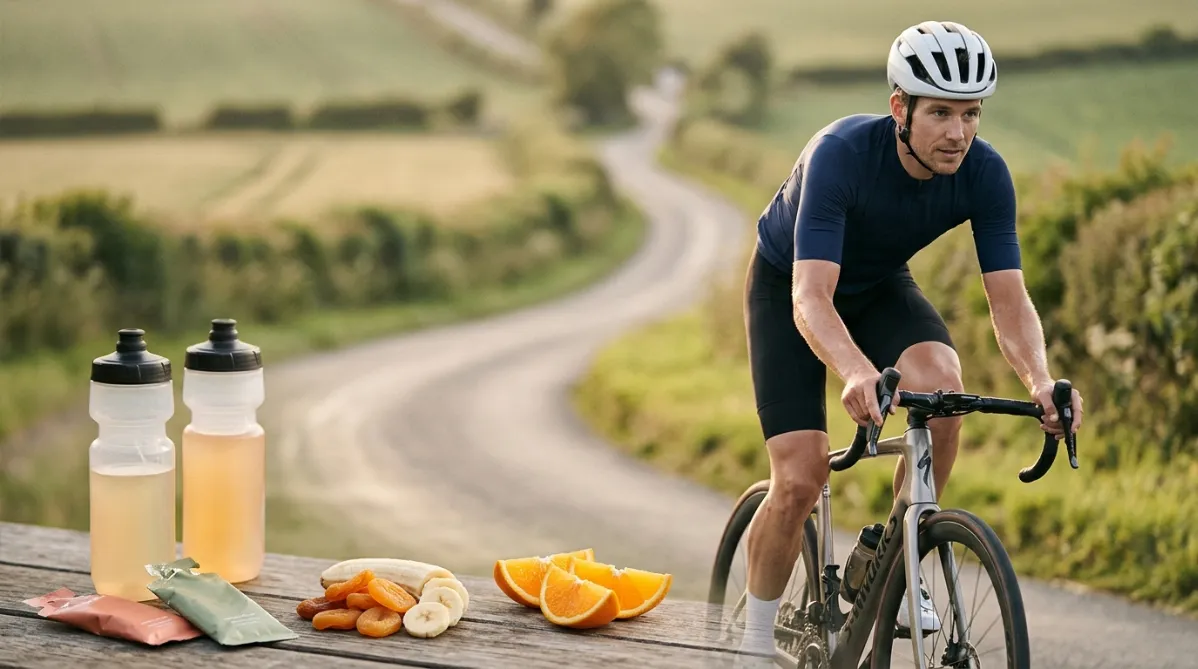
A cyclist in mid-ride, photographed from a low three-quarter side angle on a quiet country road at golden hour, wearing a matte navy jersey and a white helmet, with soft warm light catching the sweat on his forearms. His expression is calm and focused. The road bends gently through rolling green fields, and the background is softly blurred with creamy bokeh.

In the foreground on the left, a styled flat-lay-inspired still life sits on a weathered wooden surface and blends into the scene. It includes two clear water bottles with pale citrus-tinted liquid, a few torn energy gel packets in muted coral and sage, and a small pile of dried apricots and sliced banana. A handful of glossy orange slices adds a bright accent. The shallow depth of field keeps the cyclist sharp in the middle distance while the foreground items are gently softened.

The color palette is warm and editorial: soft peach, muted terracotta, sage green, cream, and deep navy. The light is natural and golden, with long, gentle shadows and a slight film-grain texture, like a high-end lifestyle or sports-science magazine spread. The composition follows the rule of thirds, with the cyclist on the right third and open negative space in the upper left, suitable for headline overlay.

The mood is energetic yet thoughtful, clean and modern, and the photograph feels authentic rather than staged. There are no logos, no readable text, and no futuristic or sci-fi elements. The overall look is crisp, airy, and refined, in the style of a contemporary health and performance journal cover.
nutrition

100 g de glucides par heure ont maintenu les cyclistes plus rapides — et le glycogène n’est pas la cause

BY COACH RYAN ·

Quatre heures après le départ d’une sortie exigeante, les cyclistes ayant ingéré 100 g de glucides par heure ont perdu moins de puissance que ceux qui n’en prenaient que 60 g. Étonnamment, le glycogène musculaire était à peu près identique dans les deux groupes. Cette étude randomisée, en double‑aveugle et en croisé, menée auprès de 15 hommes entraînés, montre qu’un autre mécanisme que l’épargne du glycogène est à l’œuvre. Nous décortiquons les chiffres, le protocole glucose / fructose 1 : 0,8 et les applications concrètes, tout en soulignant les limites liées à la petite taille de l’échantillon et à son caractère exclusivement masculin.
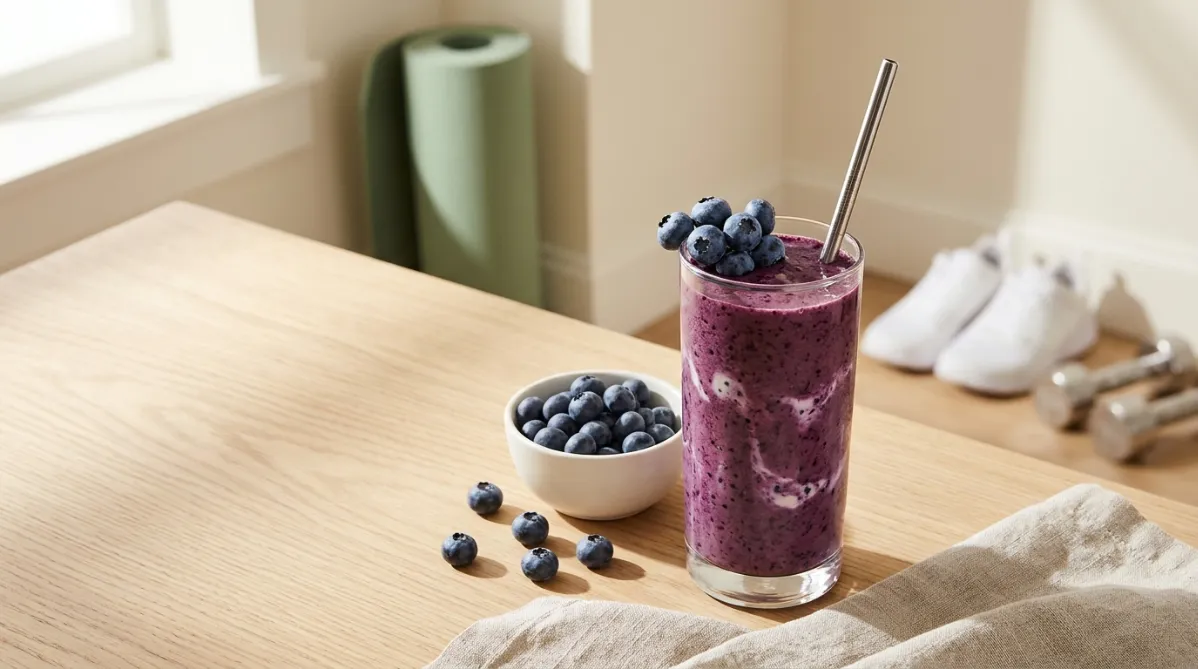
A bright, airy editorial photograph shot from above at a slight angle, showing a tall clear glass of deep violet blueberry smoothie on a pale oak wooden table. The smoothie has a creamy, velvety texture with a few lighter swirls, and a small cluster of fresh blueberries with dusty blue skins rests on the rim of the glass. A matte white ceramic bowl of whole blueberries sits to the left, with a few berries scattered naturally across the tabletop. A folded linen napkin in soft oatmeal tones and a stainless steel straw add subtle texture.

In the softly blurred background, a rolled-up sage green yoga mat leans against a light wall next to a pair of clean white running shoes and a small pair of brushed-metal dumbbells. A sliver of warm morning sunlight enters from the left window, casting gentle diagonal shadows and a golden glow across the table, with soft highlights on the glass and the berries' surface bloom.

The color palette is fresh and modern: deep indigo and violet from the smoothie, balanced by cream, warm beige, soft sage green, and touches of white. The composition follows the rule of thirds, with the glass placed on the right third and generous negative space on the left, suitable for headline overlay. Shallow depth of field, crisp focus on the glass and berries, creamy bokeh in the background. The mood is calm, healthy, and aspirational, like a contemporary wellness magazine or a trendy health journal website. Natural, realistic, high-end food and lifestyle photography style, 16:9 landscape format, clean and uncluttered.
nutrition

Le smoothie aux myrtilles aide les jambes endolories à récupérer plus rapidement

BY DR. GYMBRO ·

Dix femmes, 300 contractions excentriques du quadriceps et un smoothie aux myrtilles. Dans cet essai randomisé en croisé, la boisson aux baies a accéléré la récupération de la force isométrique maximale en 60 heures (p = 0,047), contrairement au placebo, dont la capacité antioxydante était équivalente. Cela suggère que le bénéfice ne provient pas uniquement des antioxydants. Un seul critère a atteint la signification statistique et l’échantillon était très restreint, de sorte que les résultats restent prometteurs plutôt que définitifs. Voici le protocole de l’étude, ses principaux résultats et comment les exploiter lors de vos séances de jambes les plus éprouvantes.
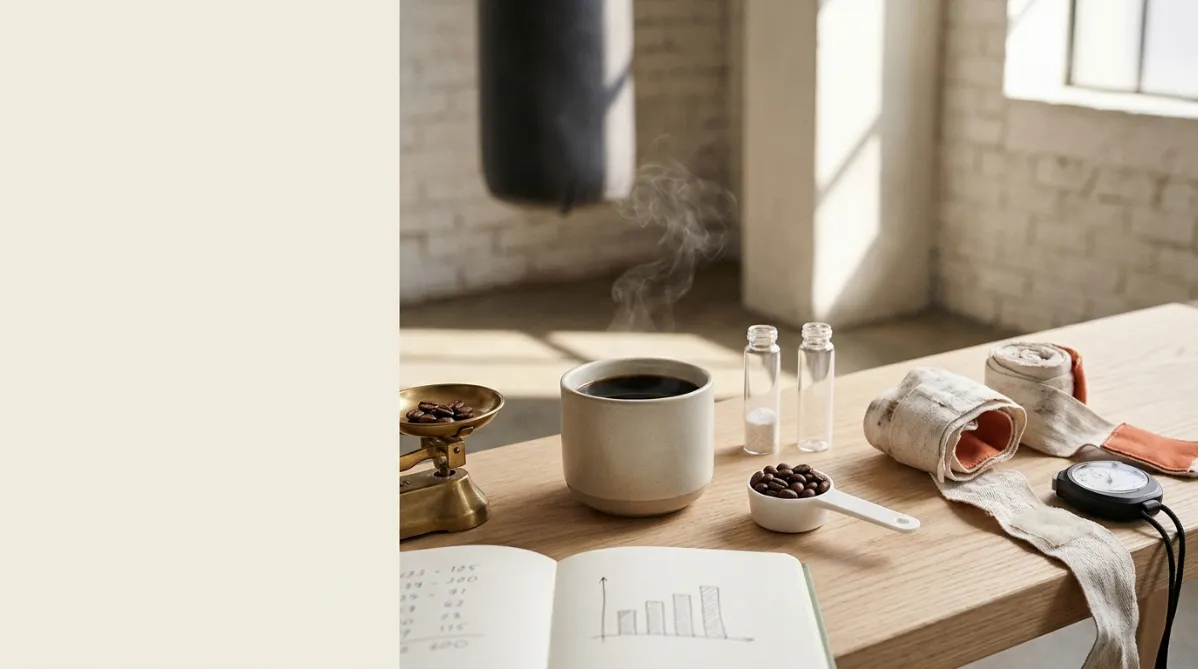
A wide, editorial-style still life shot from a slightly elevated angle on a pale oak gym bench, bathed in soft morning window light. In the center sits a matte ceramic cup of black coffee with delicate steam curling upward, flanked by a small white scoop of coffee beans and two identical glass vials, one filled with a few grains of fine powder and one empty, hinting at dose comparison. Next to the cup rests a pair of worn white boxing hand wraps, loosely coiled, and a slim black stopwatch with its face softly visible. In the foreground, a minimalist notebook lies open with blurred handwritten numbers and a simple pen sketch of a bar graph with bars of equal height, subtle and unreadable, suggesting a null result without any legible text. A small brass kitchen scale sits to the side with a few coffee beans on its tray.

In the soft-focus background, a boxing gym interior is visible: a hanging heavy bag in muted charcoal, exposed brick wall painted off-white, and tall windows casting long diagonal light across the floor. The color palette is warm and restrained: cream, sand, espresso brown, soft charcoal, with a single accent of muted terracotta orange in the hand wraps and a faint sage green in the notebook cover. Shallow depth of field with creamy bokeh, fine film grain, and gentle shadows give it a contemporary lifestyle-magazine and wellness-journal feel. The composition leaves generous negative space on the left third for headline overlay. Clean, calm, trendy, and tactile, with natural textures like wood grain, ceramic glaze, and cotton fabric. No people, no text, no futuristic elements.
science research

Le café à faible dose de caféine n’améliore pas les sprints chez les combattants d’élite

BY DR. GYMBRO ·

Vous pensez que votre café pré‑entraînement booste vos sprints ? Une étude randomisée, en double‑aveugle et croisée, menée chez 15 athlètes de combat de niveau national n’a trouvé aucun bénéfice de performance avec des doses de caféine de 1,5 et 3 mg/kg (environ 100 et 200 mg pour un athlète de 68 kg). La puissance maximale, la puissance moyenne, l’indice de fatigue et les contributions estimées des systèmes énergétiques ne diffèrent pas du décaféiné. Il s’agit toutefois d’un petit résultat nul, pas d’une preuve que la caféine échoue, et la plupart des études positives utilisent des gélules à 3–6 mg/kg. Voici le calcul des doses, les limites et ce qu’il faut réellement faire avant votre prochaine séance intense.
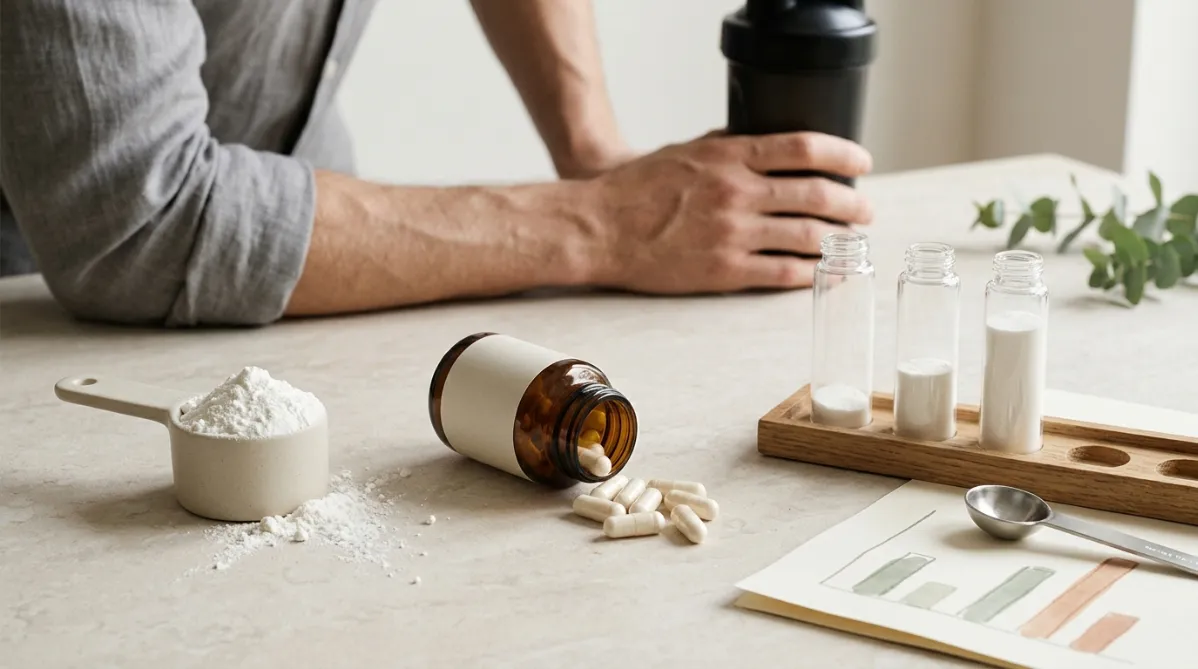
A modern editorial still life photographed from a slightly elevated angle on a pale, matte stone surface in soft natural window light. On the left, a heaping mound of fine white creatine monohydrate powder spills from a matte ceramic scoop, with a few crisp grains scattered across the surface. In the center, a small, minimalist amber glass capsule bottle sits tipped on its side, with a handful of off-white capsules spilling out. The label is blank and clean. On the right, a neat row of three clear glass lab-style vials rests on a slim oak tray. The vials hold different amounts of white powder: the first nearly empty, the second slightly fuller, the third filled almost to the brim. This quietly suggests the difference in dose and result. Beside the tray lies a simple stainless steel measuring spoon and a folded sheet of cream paper with soft, abstract bar-chart lines in muted sage green and terracotta. The lines are hand-drawn and unlabeled.

Behind the objects, slightly out of focus, a lean athletic forearm in a gray linen sleeve rests on the edge of the surface, one hand loosely holding a matte shaker bottle. This hints at a training context without showing a face. A single sprig of eucalyptus in the corner adds a soft organic touch.

The palette is warm neutral: bone white, oatmeal, soft sage, muted terracotta, and touches of amber. Shadows are gentle and long, with a shallow depth of field that gives creamy bokeh in the background. The mood is calm, clean, and trustworthy, like a premium health and science journal's feature spread, with generous negative space at the top and right for headline overlay. The composition is wide, balanced, and uncluttered, with subtle film-like grain and a natural, true-to-life color grade. No text, no logos, no futuristic elements.
nutrition

La dose indiquée de Kre‑Alkalyn n’augmente pas la créatine musculaire, le montrent les biopsies

BY DR. GYMBRO ·

La créatine tamponnée, telle que le Kre‑Alkalyn, promet une meilleure absorption, une dose plus faible et moins de ballonnements. Un essai double‑aveugle réalisé à Texas A&M a mis ces affirmations à l’épreuve en prélevant des biopsies musculaires chez 36 haltérophiles entraînés pendant 28 jours. À la dose recommandée de 1,5 g/jour, la teneur en créatine du muscle n’a pratiquement pas changé, alors que la créatine monohydrate l’a clairement augmentée. La force, la composition corporelle et les effets indésirables n’ont montré aucun avantage pour le produit tamponné.
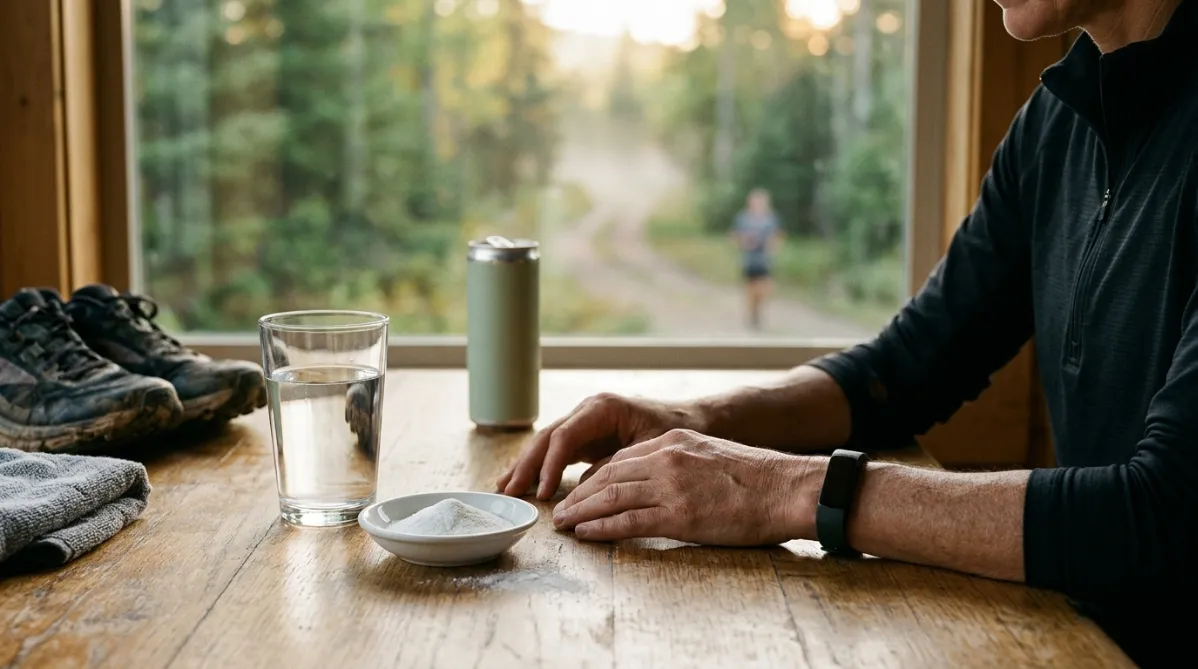
A landscape editorial photograph of a lone runner's hands resting on a weathered wooden table beside a small white ceramic dish of fine white powder and a clear glass of water, shot in soft morning light. A slim matte aluminum energy drink can, unbranded with a minimalist pale sage-green label, stands slightly out of focus in the background, with a single scoop of powder dusted lightly on the tabletop. A pair of worn running shoes and a folded gray towel sit at the edge of the frame. Through a large window behind them, a blurred misty trail winds through green trees at sunrise, with warm golden light spilling across the scene.

The color palette is calm and modern: creamy off-white, sage green, warm honey gold, and soft charcoal. The composition follows the rule of thirds, with the dish and glass in the lower left third and generous negative space on the right for a title overlay. The depth of field is shallow, with a crisp focus on the powder's delicate texture and tiny glints of light on the glass rim. The mood is clean, thoughtful, and quietly energetic, like a contemporary health and science magazine feature. Natural grain, subtle film-like softness, and gentle shadows give it an authentic lifestyle-editorial look. There are no text, logos, or futuristic elements, only tactile, real-world materials like wood, ceramic, glass, cotton, and metal.
nutrition

L’ingrédient de boisson énergisante qui augmente l’endurance à lui seul

BY DR. GYMBRO ·

Tout le monde parle de la caféine, mais l’autre ingrédient présent dans les canettes d’énergie pourrait agir discrètement à part. Une méta‑analyse de 2018, basée sur 10 études, a montré que la taurine prise seule améliore la performance d’endurance (g d’Hedges = 0,40), avec une seule dose suffisante. Ni le dosage (1‑6 g) ni la durée de la supplémentation n’influaient de façon marquée sur l’effet. Le hic : la base de preuves reste limitée et les intervalles de confiance sont larges ; il s’agit donc d’un indice prometteur, pas d’une garantie. Voici ce que la recherche a dévoilé et comment consommer la taurine de façon raisonnée.
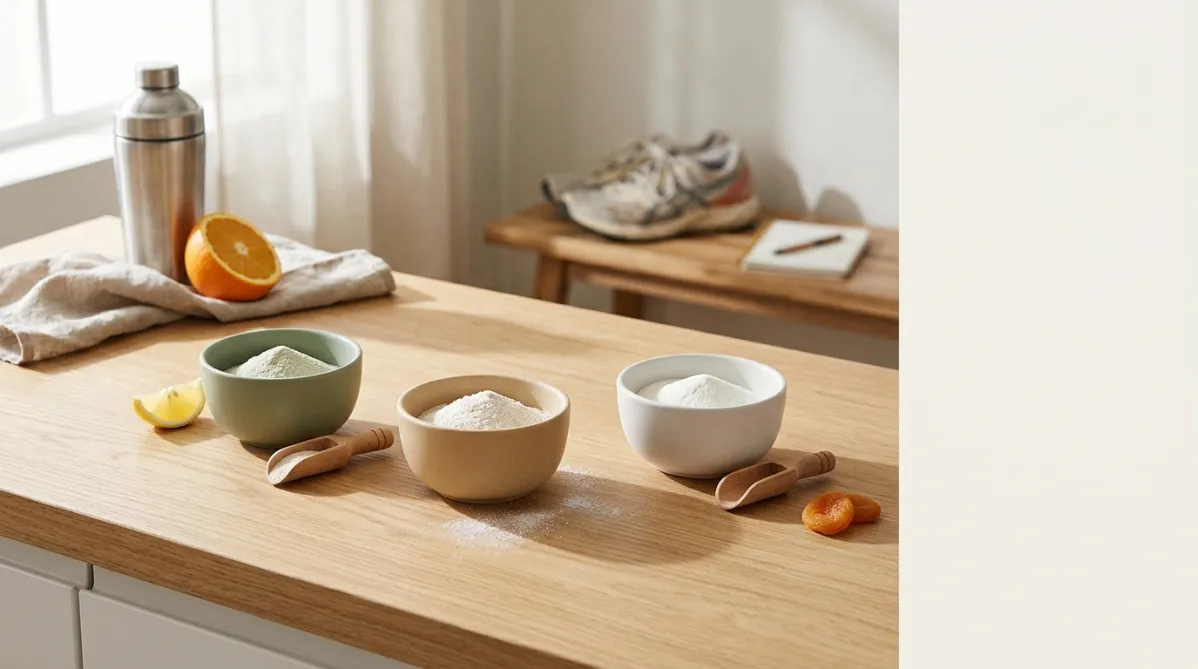
A landscape editorial photograph of a clean, sunlit kitchen-counter or light oak table, shot from slightly above at a gentle angle. Three small matte ceramic bowls in muted sage green, warm sand, and soft white sit in a loose row. Each holds a different fine white powder, and each has a small wooden scoop resting beside it. The middle bowl is slightly closer to the camera and sharper in focus, with a faint dusting of powder spilling onto the surface. In the soft-focus background, a stainless steel shaker bottle and a half-peeled orange sit beside a folded linen napkin, suggesting citrus without being literal. A single lemon wedge sits near the left bowl, and a small dried apricot sits near the right, a subtle visual nod to citrate and pyruvate.

In the background, a blurred athletic scene: a running shoe resting on a wooden bench and a small notebook with a pen, suggesting a training log. Soft diffused morning light enters from the left through a window and casts long, gentle shadows. The palette is warm neutrals, creamy whites, soft greens, and a hint of terracotta orange. The look is a modern wellness magazine with a shallow depth of field, a fine-grain film feel, and generous negative space on the right third of the frame for title text. The mood is calm, trustworthy, and scientific yet approachable, with no text, labels, or logos.
nutrition

Créatine pyruvate vs citrate : quelle forme a maintenu la force plus longtemps

BY DR. GYMBRO ·

Deux formes de créatine ont dépassé le placebo lors d’un essai de 28 jours. La créatine pyruvate a conservé son effet sur la force pendant les dix intervalles d’effort maximal, alors que la créatine citrate a perdu son avantage dès le sixième intervalle. En plus, le pyruvate a amélioré la vitesse de relaxation et la consommation d’oxygène au repos. L’étude n’incluait toutefois pas de groupe monohydrate. Voici ce que les chiffres montrent, ce qu’ils ne montrent pas, et comment choisir la forme la plus adaptée.
A wide, landscape editorial photograph with soft natural morning light. In the foreground, a rustic matte ceramic bowl rests on a pale oak wooden table, filled with vivid deep-green spirulina powder heaped in a gentle mound. A small wooden spoon dusted with the powder lies beside it, and a few scattered green flecks dust the surface. Next to the bowl sits a clear glass of water with a swirl of emerald green just blending in, catching sunlight and casting soft green-tinted shadows.

In the middle ground, slightly out of focus, a pair of worn running shoes in muted sage and cream tones sits on the edge of the table, laces loosely undone. A simple analog stopwatch with a clean white face lies beside them, its hands frozen at a moment suggesting a close finish. A folded linen towel in warm oatmeal tone drapes casually nearby.

The background is a softly blurred outdoor setting seen through a large window: a quiet tree-lined running path at dawn, with golden-hazy light, dewy greenery, and a faint mist. The color palette is calm and modern: deep emerald, sage, cream, warm wood, and touches of soft gold. The composition leaves generous negative space on the right side for headline text, with a shallow depth of field, crisp detail on the powder texture, and a clean, minimalist, lifestyle-magazine aesthetic. Subtle film-like grain, natural shadows, and a fresh, healthy, energetic mood. No people, no text, no logos.
nutrition

La spiruline a aidé les coureurs à tenir 32 % plus longtemps — mais il y a un hic

BY DR. GYMBRO ·

Des coureurs ayant pris de la spiruline pendant quatre semaines ont tenu environ 32 % plus longtemps lors d’un effort maximal après une séance épuisante de deux heures. L’étude a également montré une hausse de 10,9 % de l’oxydation des graisses et des niveaux accrus de l’antioxydant glutathion. Mais avant de vous précipiter, sachez que seul un échantillon de neuf hommes a été testé et que le gain réel en conditions normales n’était que d’environ 39 secondes. Voici ce que révèle la recherche, pourquoi cela pourrait fonctionner et comment l’essayer en toute sécurité.
A quiet bedside scene at dusk, shot in soft natural light with a shallow depth of field. A tall frosted glass of creamy, pale-white shake sits on a light oak nightstand, with a thin film of condensation on the glass and a faint milky residue near the rim. Beside it, a matte ceramic scoop rests on a small linen coaster. A minimalist tub of unbranded protein powder in muted sage green sits slightly out of focus in the background.

To the left, a neatly made bed with oatmeal-colored linen sheets and a rumpled cream duvet. A pair of worn lifting gloves and a folded gray gym towel sit on the edge of the bed, suggesting an evening workout just finished. A small analog alarm clock reads about 10:30 PM, its soft face glowing faintly. A sprig of dried eucalyptus in a small stoneware bud vase adds an organic touch.

Through a large window on the right, deep indigo twilight fades into a warm amber horizon, and the last light spills across the wall in long, gentle gradients. A sheer curtain moves slightly. The palette is warm neutrals (cream, oak, sand, soft terracotta) with a few muted blue-violet accents from the evening sky.

The composition uses the rule of thirds, with the glass at the left-center foreground and generous negative space on the right, where headline text could sit. The mood is calm, restorative, and editorial, like a modern wellness and nutrition journal. The lighting is gentle and diffused, with subtle film grain and slightly lifted shadows. The textures of linen, wood, glass, and ceramic are crisp. The image is clean and uncluttered, with no text, logos, or people, and no futuristic or sci-fi elements.
nutrition

Le shake de 40 g avant le coucher : ce que la caséine pré‑sommeil fait pendant la nuit

BY DR. GYMBRO ·

Faire une séance de musculation le soir, puis jeûner pendant les huit heures qui suivent, compromet-il la récupération ? Une étude de 2012 a administré 40 g de caséine à 16 jeunes hommes, 30 minutes avant le coucher, et a suivi les effets pendant la nuit. La protéine a été digérée et absorbée, la synthèse protéique totale a bondi (311 vs 246 µmol/kg) et le bilan protéique net est passé d’un léger déficit à un excédent. La synthèse des protéines musculaires était environ 22 % plus élevée, bien que la différence ne soit que marginalement significative. Voici ce que ces résultats impliquent, leurs limites et comment les exploiter.
A clean, editorial still life shot from a slightly elevated angle on a pale oatmeal-colored stone countertop, lit by soft natural window light from the left that casts long, gentle shadows. In the center sits an open, unlabeled amber glass supplement bottle on its side, with a small scatter of cream and white capsules spilling toward the viewer. Beside it, a matte ceramic dish holds a few capsules and a pinch of coarse sea salt. To the right, a neatly arranged group of whole foods that are natural zinc and magnesium sources: halved oysters on a small slate board, a small bowl of pumpkin seeds, a handful of raw cashews, and a few dark green spinach leaves. In the left foreground, a worn leather gym notebook lies open with minimal handwritten tally marks and a simple hand-drawn flat line graph in dark ink, with a brass pen resting across it. A single chrome dumbbell handle edges into the frame at the far left, softly out of focus, and a folded charcoal gym towel sits at the top right corner. The palette is warm and muted: sand, cream, sage green, amber, and charcoal, with a subtle terracotta accent in the ceramic dish. The depth of field is shallow, with the capsules and bottle in crisp focus and the background gently blurred into a soft beige haze. The mood is calm, thoughtful, and skeptical, like a modern health and science magazine feature. The composition leaves generous negative space on the upper right for headline text. The texture is tactile and fine-grained, with a subtle film-like softness and natural contrast. Wide landscape 16:9 framing.
science research

ZMA et testostérone ? 8 semaines chez des haltérophiles n’ont rien donné

BY DR. GYMBRO ·

Le ZMA a bâti sa réputation sur des affirmations audacieuses concernant la testostérone, un lien avec le scandale BALCO et une première étude de football qui semblait prometteuse. Des chercheurs ont ensuite testé le produit de façon plus stricte : 42 hommes entraînés, en double‑aveugle, pendant huit semaines d’entraînement standardisé. Le taux sérique de zinc a légèrement augmenté, mais sans différence significative, et aucun changement n’a été observé sur les hormones, la force, la composition corporelle, l’endurance ou la puissance anaérobie. Voici ce que l’étude a réellement montré, pourquoi la carence reste une question à part, et ce que les pratiquants devraient plutôt faire.
A wide, editorial-style flat lay photographed from above on a pale, warm-gray stone surface lit by soft natural window light. On the left, a matte white supplement sachet and a small frosted glass jar of off-white probiotic powder sit beside a wooden scoop dusted with fine granules. In the center, a modern minimalist stopwatch with a brushed silver case and crisp white face rests on a folded slate-blue running towel, its hands frozen just past the half-minute mark. On the right, a pair of sleek running shoes in cream and sage green are angled diagonally, with a few strands of laces trailing across the surface. Scattered around the arrangement are fresh, natural gut-health cues: a halved kefir-colored ceramic bowl of creamy yogurt with a drizzle of honey, a few sprigs of fresh mint, sliced green apple, and a handful of raw oats. A small glass of water with delicate condensation catches a soft highlight in the background. The color palette is calm and refined: sage green, cream, soft slate blue, and touches of warm honey gold against the neutral stone. Shadows are long and gentle, creating depth and a quiet, premium wellness-journal mood. The shallow depth of field softly blurs the edges, leaving the stopwatch and probiotic jar in crisp focus. Negative space on the upper right of the composition leaves room for a headline overlay. The overall feel is clean, modern, and trendy, like a contemporary health and sports science magazine cover, with realistic textures, natural tones, and no futuristic or digital elements.
nutrition

Probiotique SLAB51 : une semaine d’administration ajoute 33 secondes chez les athlètes d’élite

BY DR. GYMBRO ·

Une semaine de probiotiques multisouches SLAB51 a permis à des athlètes d’élite de tenir environ 33 secondes de plus à un test sur tapis roulant, alors qu’une prise unique n’a rien changé et que le VO₂max est resté stable. L’étude, en double‑aveugle, randomisée et croisée, a également montré une hausse de l’enzyme antioxydante SOD avant l’effort. Mais les résultats proviennent d’un petit échantillon d’hommes d’élite et d’une intervention très courte. Que signifie réellement cet apport d’endurance ? Voici le détail de la conception de l’étude, des chiffres et ce que les sportifs peuvent en retenir concrètement.
A bright, minimalist editorial still life shot from a slightly elevated three-quarter angle on a pale oat-colored stone countertop, bathed in soft natural window light with gentle long shadows. In the center sit two matching matte white supplement scoops, side by side. One is heaped with fine white crystalline powder, the other holds an almost identical pile, so the viewer is invited to compare them. Beside them are two simple frosted glass tumblers of cloudy water, each with a small whisper of powder swirling at the bottom. A third glass of clear water sits slightly apart, as a quiet nod to the placebo.

Scattered around the scene are fresh, sliced watermelon wedges with vivid coral-pink flesh and pale green rinds, and a few sliced green apples with crisp white interiors, hinting at the natural sources of citrulline and malic acid. A small brushed-brass measuring spoon and a minimalist matte sage-green shaker bottle rest at the edge of the frame. Off to one side, a clean ceramic dish holds a few loose grains of powder, and a slim linen notebook with a pencil lies open to a blank page, suggesting data and study notes without any legible text.

The color palette is soft and modern: warm cream, blush coral, sage green, and touches of brass, with a faintly blurred background of a sunlit kitchen or studio with a pale plaster wall. Shallow depth of field keeps the scoops tack sharp while the background melts into a creamy bokeh. The composition leaves generous negative space on the left third of the frame for a title overlay. The overall mood is calm, trustworthy, and trendy, like a contemporary wellness and science journal cover, with crisp detail, subtle film-like grain, and a clean, airy, balanced feel.
science research

Citrulline Malate vs L‑Citrulline : le malate est‑il vraiment important ?

BY DR. GYMBRO ·

Citrulline malate ou L‑citrulline pure ? Un protocole randomisé, double‑aveugle, contrôlé par placebo et en cross‑over, mené chez 43 adultes entraînés, a comparé les deux formes à un placebo, et la réponse pourrait vous faire économiser. Aucun des deux n’a amélioré la force, la puissance, la performance au saut, le nombre de répétitions ni la perception de l’effort, et le malate n’a rien apporté de supplémentaire par rapport à la même dose de citrulline. Voici ce que l’étude a mesuré, les doses employées et les réserves qui empêchent de tirer une conclusion définitive. Si vous hésitez encore sur le produit à mettre dans votre shaker, commencez par lire ceci.
A wide, editorial-style flat lay photographed from slightly above on a pale oak gym bench with a soft matte finish. On the left, a small white ceramic cup of black coffee sits on a matching saucer, with a thin curl of steam rising and catching warm window light. Beside it is a second, slightly larger handleless stoneware mug in muted sage green, also filled with coffee, so the pair suggests one to two cups. In the center-right foreground rests a sleek matte-black steel barbell plate, partly overlapping a brushed-steel dumbbell with fine knurling. A folded charcoal gym towel and a clean white chalk-dusted wrist strap lie casually to one side. A small scatter of whole roasted coffee beans spills across the bench in front of the cups, glossy and deep brown. Near the bottom edge, a minimalist analog kitchen scale in soft cream with a thin black needle hints at precise dosing, without any readable numbers or text.

Soft morning sunlight streams in from the upper left, creating long, gentle shadows and a warm golden glow against cool neutral tones. The background is a softly blurred, airy home gym or boutique training studio with out-of-focus squat rack uprights, pale concrete walls, and a leafy green plant in a terracotta pot adding a touch of organic color. The palette is restrained and modern: warm cream, espresso brown, charcoal, sage green, and hints of brushed silver. Shallow depth of field keeps the cups and beans tack sharp while the background melts into creamy bokeh. The composition leaves generous negative space on the right third for a title overlay, with a balanced, calm, premium magazine feel, like a contemporary wellness and sports science journal. High-resolution, natural color grading, subtle film grain, realistic textures on ceramic, steel, and coffee crema.
nutrition

Quel dosage de caféine avant de soulever ? Une méta‑analyse montre que 1–2 mg/kg suffisent

BY DR. GYMBRO ·

Le dosage habituel de caféine avant une séance de musculation est de 3 à 6 mg/kg, soit plusieurs tasses de café ou une forte dose de pré‑entraînement. Une méta‑analyse de 2022, portant sur 12 essais, a montré que même 0,9 à 2 mg/kg amélioraient la force (d ≈ 0,17), l’endurance (d ≈ 0,21) et la vitesse moyenne de la barre (d ≈ 0,56). Pour la plupart des pratiquants, cela correspond à une ou deux tasses de café. Les effets restent modestes et proviennent d’études aiguës, mais ils suggèrent qu’on peut obtenir un bénéfice comparable avec beaucoup moins de caféine.
A cyclist in a fitted matte-black kit, shot from a low three-quarter angle, rides a sunlit country road at early morning, slightly out of focus with soft motion blur on the wheels. In the foreground on the left sits a rustic wooden table with a tall glass of deep magenta beetroot juice. Condensation beads on the glass, and the light catches its vivid jewel-toned color. Beside it lie two whole beetroots with their leafy red-veined greens still attached, and one halved beet shows concentric crimson-and-pink rings. A small linen napkin and a scatter of water droplets add an editorial still-life feel.

The background is a gently rolling landscape with golden-green fields and a thin ribbon of asphalt curving toward the horizon. Pale mist hangs low and warm sunlight comes from the right, creating long soft shadows and a golden rim light on the glass and the cyclist's silhouette. The shallow depth of field keeps the juice and beets crisp while the rider stays a dreamy blurred suggestion of speed.

The palette is rich magenta, burgundy, warm cream, sage green, and soft gold, with muted, slightly desaturated tones in the background so the beetroot color stands out. The composition follows the rule of thirds, with the still-life in the lower left third and open negative space in the upper right for the title. The overall look is a clean, modern lifestyle-magazine photograph with natural film-like grain, calm and athletic, and no text, logos, or futuristic elements.
nutrition

Jus de betterave avant un contre-la-montre : comment un demi‑litre a réduit de près de 3 % les temps sur 4 km et 16,1 km

BY DR. GYMBRO ·

Une petite étude croisée menée en 2011 a testé si un demi‑litre de jus de betterave pouvait accélérer les contre‑la‑montre de cyclistes compétitifs. Neuf hommes ont bu 0,5 L de jus riche en nitrate (environ 6,2 mmol) 2,5 h avant la course. Le nitrite plasmatique a plus que doublé, la puissance moyenne a augmenté et les temps sur 4 km et 16,1 km se sont améliorés de 2,8 % et 2,7 % respectivement, sans modification du VO₂. Ces résultats suggèrent surtout une meilleure économie de pédalage plutôt qu’une hausse de la capacité aérobie. Voici le protocole, les chiffres et les limites de ces données.
A calm, modern editorial still life shot from a slightly elevated angle on a pale oak wooden table, bathed in soft morning window light with gentle diffused shadows. In the center-left, a small matte ceramic bowl in warm oatmeal tone holds a measured heap of fine, creamy-white collagen peptide powder, with a minimalist wooden scoop resting beside it. Next to it sits a clear glass of water with delicate condensation. On the right side of the frame, a rolled-up sage green yoga mat leans against a light plaster wall, and a pair of clean, minimalist white running sneakers sits slightly off-center, one tilted to show the heel and the back of the ankle area. A thick, natural-fiber resistance band in muted terracotta is coiled loosely in the foreground. In the background, a wooden step or low plyometric box suggests calf-raise exercise, softly out of focus. A small linen notebook lies open with a handwritten simple line graph showing two rising lines, one steeper than the other, with a thin pencil beside it, and no legible text. A sprig of dried eucalyptus in a slim bud vase adds an organic touch. The palette is warm neutrals: cream, oat, sand, soft terracotta, sage, with a subtle pop of muted coral. The mood is thoughtful, health-conscious, and reassuring, like a premium wellness and sports science magazine. Shallow depth of field, crisp texture on the powder and wood grain, subtle film-like grain, generous negative space on the upper left of the frame for headline overlay. Landscape 16:9 composition, clean, uncluttered, airy, and contemporary.
nutrition

Le hack des 5 g d’Achille : pourquoi les peptides de collagène ont boosté les gains précoces de rééducation au‑delà du seuil clinique

BY DR. GYMBRO ·

Une rééducation de l’Achille qui stagne décourage rapidement. Une petite étude pilote de 2019 suggère que 5 g de peptides de collagène par jour, associés à un programme de renforcement du mollet, pourraient accélérer les premiers progrès. Après trois mois, le groupe collagène a progressé de 12,6 points au questionnaire VISA‑A, contre 5,3 points pour le placebo — un gain largement supérieur au seuil clinique de 6,5 points. Tous les participants suivaient le même entraînement bi‑quotidien, ce qui montre que l’exercice reste le pilier du traitement. Voici le protocole, les chiffres, les patients concernés et les précautions à prendre avec un échantillon de seulement 20 participants.
A wide, editorial still life photographed in soft natural window light on a pale oatmeal-colored linen surface. At the center sits a small, rustic ceramic dish holding a handful of dried golden-orange Rhodiola rosea root pieces and a few fresh, fleshy green-gray succulent rosettes with rosy-pink tips. Beside it, a single matte amber glass capsule bottle lies on its side, with two cream-colored capsules spilling out. On the left, a minimalist analog stopwatch with a brushed brass case rests slightly out of focus, its hands suggesting a duration just past the quarter-hour mark. On the right, a worn, chalk-dusted steel kettlebell handle and a folded charcoal gym towel fill the negative space, hinting at lifting without showing a full gym scene.

In the foreground, a neat row of seven tiny ceramic pill cups arranged in a gentle diagonal line, the first cup holding one capsule and the rest sitting empty, as a quiet visual metaphor for a single dose versus daily dosing. A sprig of dried alpine moss and a few small speckled pebbles add organic texture. The background is a softly blurred warm-gray plaster wall with a gentle gradient shadow cast by a window frame, creating diagonal light stripes across the scene.

The palette is muted and earthy: sage green, terracotta, warm cream, brushed brass, and soft charcoal, with one subtle pop of coral from the Rhodiola tips. Shallow depth of field, crisp focus on the root and capsules, and fine film-like grain. The composition leaves generous clean negative space in the upper left for a headline overlay. The overall feel is a modern wellness and science journal: calm, tactile, minimal, and sophisticated, with a slightly moody, high-end magazine look. There is no text, no people, and no futuristic elements.
nutrition

200 mg de rhodiola offrent aux athlètes d’endurance 24 secondes supplémentaires ; quatre semaines de prise quotidienne n’ajoutent rien

BY DR. GYMBRO ·

Une dose unique de 200 mg de Rhodiola rosea prise une heure avant l’effort a fait passer le temps d’épuisement de 16,8 à 17,2 minutes, soit un gain d’environ 24 secondes, et a augmenté le VO₂max dans une étude croisée en double‑aveugle. En revanche, quatre semaines de prise quotidienne n’ont pas renforcé cet effet, ni modifié aucune autre variable mesurée. Le gain est très modeste, la force, le temps de réaction et l’attention restent inchangés. Voici ce que l’étude a réellement montré, qui pourrait justifier une utilisation aiguë, et pourquoi il ne faut pas compter sur un « chargement » de rhodiola.
Créatine avant ou après l’entraînement ? Une petite étude donne l’avantage à la prise post‑entraînement
nutrition

Créatine avant ou après l’entraînement ? Une petite étude donne l’avantage à la prise post‑entraînement

BY DR. GYMBRO ·

Doit‑on consommer de la créatine avant ou après la séance de musculation ? Une étude de 2013, menée auprès de 19 bodybuilders masculins, a montré que la prise post‑entraînement était légèrement supérieure à la prise pré‑entraînement en termes de masse maigre, de masse grasse et de développé couché. Cependant, le test statistique officiel n’a pas mis en évidence de différence significative entre les deux groupes, les auteurs se limitant à l’hypothèse prudente de « possiblement plus bénéfique ». Cet article détaille ce que révèlent réellement les données, l’importance de la taille de l’échantillon, et comment appliquer ces résultats avec une routine simple de 5 g par jour.
A landscape, editorial-style flat lay photographed from above on a pale oak gym bench or a matte light-gray concrete surface. On the left side, a clear glass of water sits next to a small matte white ceramic bowl of fine white creatine powder, with a wooden scoop resting beside it and a few loose grains scattered naturally on the surface. In the center, a modern analog wall-style clock face is replaced by a simple minimalist stopwatch in brushed steel, its hands paused, subtly suggesting timing without any text or numbers emphasized. On the right, a neatly folded charcoal gym towel and a single chalk-dusted dumbbell handle enter the frame at the edge, with a faint dusting of white chalk on the wood. A small linen notebook with a pencil rests slightly off-center, its pages blank, hinting at data and study without any readable writing.

The color palette is soft and restrained: warm cream, oatmeal, sage green, and muted slate, with one accent of terracotta orange in the pencil or a small ceramic dish. Light comes from a large window at the upper left, casting long, gentle diagonal shadows and a soft highlight across the glass of water, creating delicate caustic reflections on the surface. The depth of field is shallow, with the creatine bowl and scoop in crisp focus and the edges softly blurred. The composition leaves generous negative space on the upper right for a headline overlay. The overall feel is calm, clean, and contemporary, like a wellness and science journal's cover image, with natural textures, subtle film grain, and a refined, premium magazine look. No people, no logos, no text, and no futuristic elements.
nutrition

Créatine avant ou après votre entraînement ? Une petite étude donne l’avantage post‑entraînement

BY DR. GYMBRO ·

Faut‑il prendre de la créatine avant ou après votre séance de musculation ? Une étude de 2013 menée auprès de 19 bodybuilders masculins a montré que la prise post‑entraînement semblait légèrement supérieure à la prise pré‑entraînement en termes de masse maigre, de masse grasse et de développé couché. Cependant, le test statistique formel n’a pas révélé de différence significative entre les groupes, les auteurs s’appuyant sur une inférence prudente « possiblement plus bénéfique ». Voici ce que disent réellement les données, pourquoi la taille de l’échantillon compte, et comment appliquer les résultats avec une routine simple de 5 g par jour.
A wide, editorial-style still life photographed on a pale limestone countertop in soft morning window light. At the center sits a matte white scoop of fine white powder resting beside a frosted glass tumbler of cloudy, pale pink-orange water, with a few watermelon slices and a halved wedge showing glossy coral flesh and thin green rind, a nod to citrulline's natural source. To the left, a neatly folded charcoal gym towel and a brushed steel dumbbell rest at the edge of the frame, slightly out of focus. To the right, a minimalist open notebook with a few hand-drawn tally marks and a simple line graph sketched in black ink rises toward the right edge, next to a slim mechanical pencil and a small analog stopwatch with a clean white face. A few loose grains of powder are scattered across the stone, catching the light. Soft diagonal shadows fall across the surface from a nearby window, and a gentle sage-green wall in the background adds calm contrast. The palette is warm cream, watermelon coral, sage green, and soft graphite gray, with plenty of negative space on the upper left for headline overlay. Shallow depth of field, crisp focus on the powder scoop and watermelon, subtle film grain, natural tones, and a clean, modern wellness-journal aesthetic. Shot at eye level with a slight downward angle, like a contemporary health and science magazine cover. No text, no logos, no people.
nutrition

8 g de Citrulline Malate = 53 % de répétitions en plus et 40 % de courbatures en moins ? Ce que montre l’étude

BY DR. GYMBRO ·

Un essai croisé de 2010 a révélé qu’une dose unique de 8 g de citrulline malate permettait d’enchaîner environ 53 % de répétitions supplémentaires au développé couché lors du dernier set testé, tout en réduisant d’environ 40 % les courbatures ressenties à 24 et 48 h. L’effet se manifestait surtout en fin de séance, quand la fatigue était déjà bien installée. Tous les participants ont montré ce bénéfice, mais il ne s’applique pas aux séries légères avec de longues pauses. Environ 15 % des sujets ont signalé des troubles gastriques, un point à ne pas négliger.
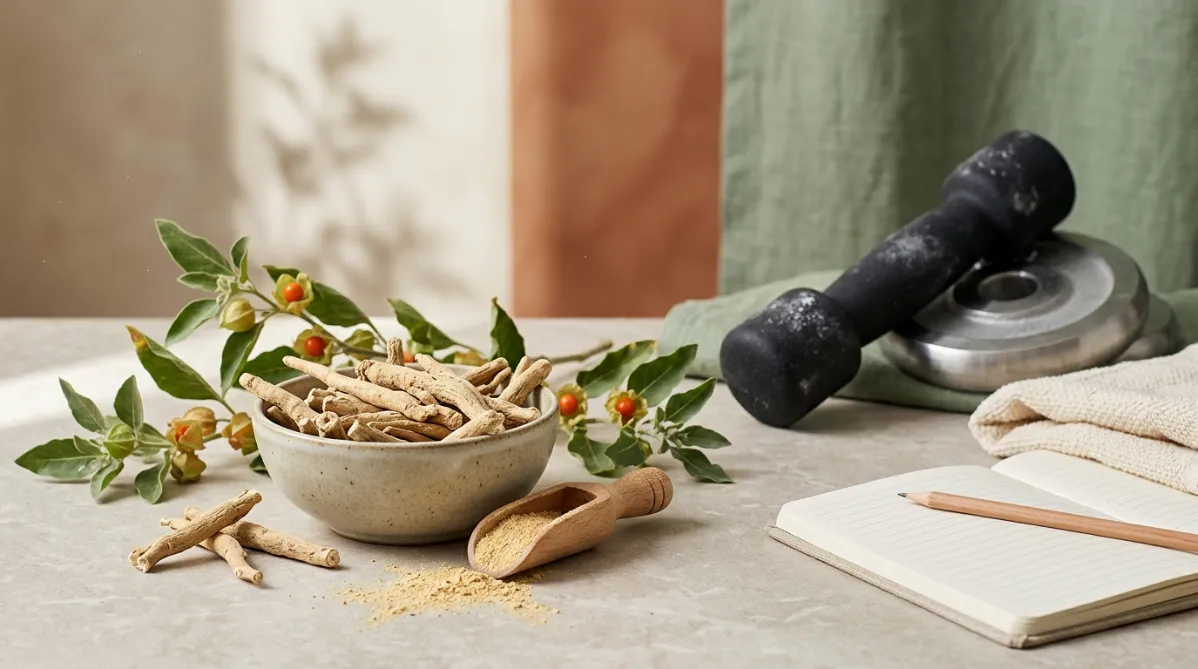
A wide editorial still life on a pale, warm-gray stone surface lit by soft morning window light from the left. In the foreground, a rustic ceramic bowl in matte oatmeal glaze holds dried ashwagandha roots, pale tan and gnarled, with a few scattered beside it. A small wooden scoop dusted with fine golden-beige powder rests next to the bowl. Behind them, a few olive-green ashwagandha sprigs with small orange-red berries in papery husks arc across the frame, adding a quiet pop of color.

Midground right: a matte black chalk-dusted dumbbell handle and a single brushed-steel weight plate lean casually against a linen-textured backdrop in muted sage. A folded cream cotton towel and a slim notebook with a pencil suggest a training log. The notebook is open to blank, softly lined pages with no legible text.

The background fades into a gentle blur of neutral beige and soft terracotta tones, with a hint of a plant shadow cast across the wall in dappled light. Fine dust and powder particles float in the light beams, giving a tactile, organic feel.

The composition follows the rule of thirds: botanical elements on the left and center, gym elements on the right, and negative space in the upper right for headline overlay. Shallow depth of field, crisp focus on the roots and powder, creamy bokeh behind. Color palette: sage green, warm sand, terracotta, charcoal black, and a touch of burnt orange. The mood is calm, modern, and trustworthy, like a premium wellness and science magazine. Photographed on a 50mm lens, natural grain, subtle film-like contrast, clean minimalist styling, high-end editorial photography.
nutrition

L'herbe ancestrale qui a surpassé le placebo dans un essai de musculation de 8 semaines : force, taille musculaire et testostérone

BY DR. GYMBRO ·

Une racine ayurvédique vieille de plusieurs siècles pourrait-elle réellement dépasser un placebo en musculation ? Dans une étude randomisée de 8 semaines portant sur 57 novices, les hommes ayant pris 300 mg d’extrait d’ashwagandha deux fois par jour ont gagné davantage en force au développé couché, en volume des bras et de la poitrine, ainsi qu’une plus forte hausse de testostérone que le groupe placebo, tout en perdant plus de masse grasse. L’étude reste toutefois petite, courte et limitée aux hommes débutants. Voici les données, le protocole, les profils qui pourraient en bénéficier et les réserves à garder en tête.

This page is available in